Web Design & SEO Blog
The SENAVIA web design and SEO blog explains how small businesses get found and chosen online: websites that turn visits into inquiries, local and technical SEO, visibility in AI answers such as ChatGPT and Google AI Overviews, and custom web development. Every guide links its sources.
Editor's Picks
 Web Design
10 Website Design Mistakes That Drive Customers Away
 Web Development
Custom Website Design Benefits for South Florida Small Businesses
 Search & Marketing
Benefits of Responsive Web Design for South Florida Businesses
 Web Design
How Web Design Affects Local SEO for South Florida Businesses
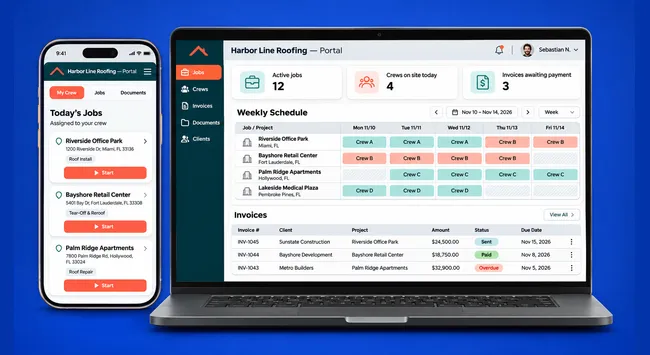
From Website to Subcontractor Portal: When Crews, Jobs and Invoices Need One Place
A subcontractor portal makes sense when one job lives in several files, crews text for addresses and invoices stop matching payments. SENAVIA builds that kind of portal in South Florida, starting at $9,475 and shaped around your own crews, jobs and invoices.
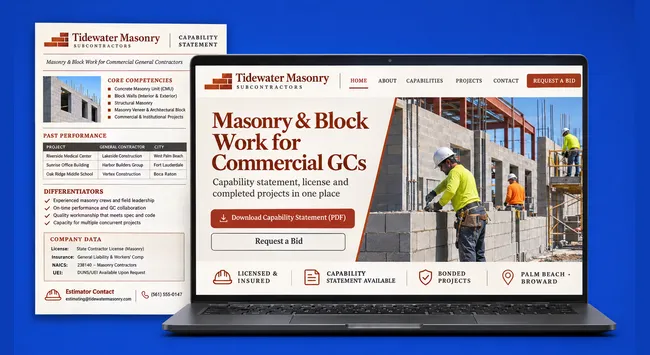
The subcontractor capability statement: what to include and how to publish it
A subcontractor capability statement is a short summary of your trades, counties, crew, license, insurance and past work that a general contractor or estimator can read quickly. SENAVIA shows what to include and how to publish it as a web page and a PDF for South Florida subs.
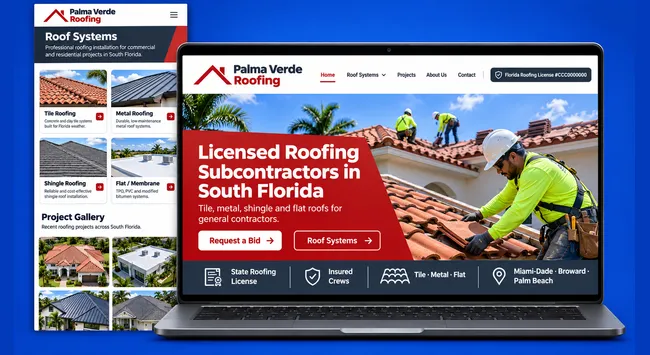
Roofing Subcontractor Website in Florida: License, Roof Systems and What a General Contractor Looks For
A roofing subcontractor website should show the Florida roofing license, one page for each roof system and captioned photos of finished roofs, so a general contractor can verify and shortlist you in one visit. SENAVIA builds these sites for roofers across South Florida, in English and Spanish.
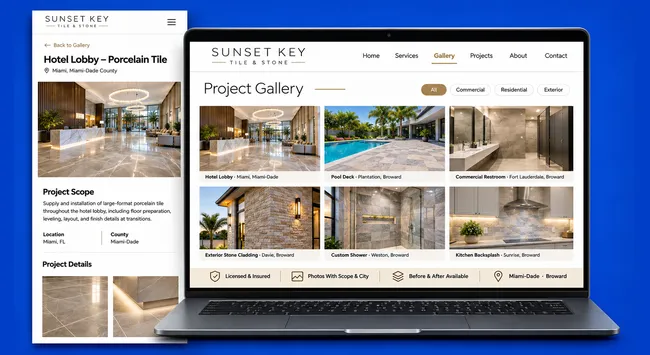
Project photos that win bids: finished work photos for a subcontractor website
On a construction project photos website, finished and recognizable work, sorted by type and captioned with scope, city and county, helps a general contractor judge a sub quickly. SENAVIA explains how to choose, organize and publish that work for South Florida subcontractors.
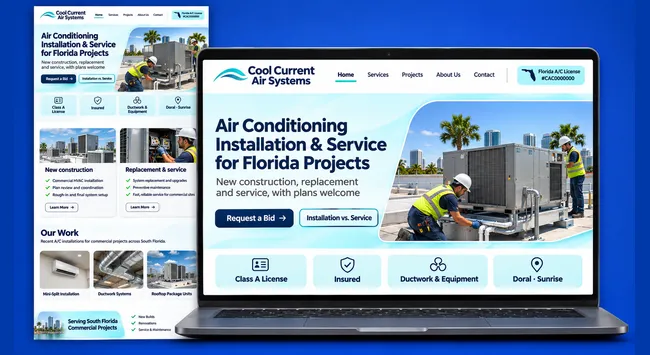
Florida HVAC Subcontractor Website: License, Installation and Service, and What a General Contractor Reviews
An HVAC subcontractor website in Florida should show the state air conditioning license, separate pages for installation and service, and a form that takes plans. SENAVIA, a web design agency serving South Florida, explains what a general contractor reviews before inviting you to bid.
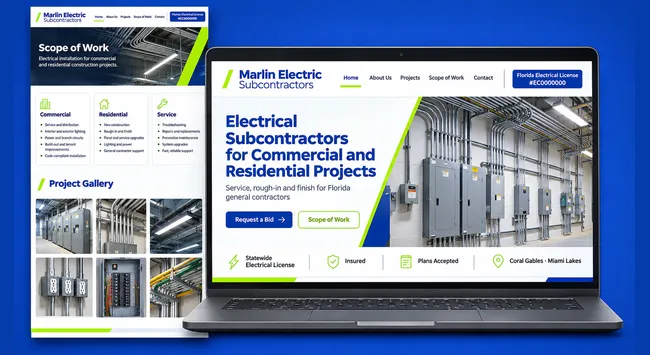
Electrical Subcontractor Website in Florida: License, Scope and What a General Contractor Reviews
An electrical subcontractor website in Florida should show the DBPR license category and number, the counties covered and a bid form that takes plans. SENAVIA, a web design agency for South Florida trade companies, explains what a general contractor reviews first.
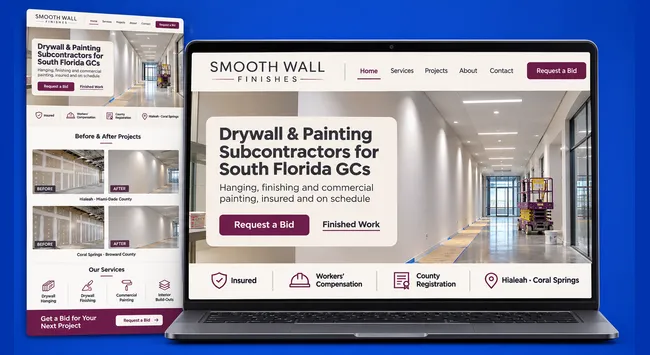
Drywall and Painting Subcontractor Website in Florida: What to Show When There Is No State License
A drywall and painting subcontractor website should show insurance, finished jobs with photos, crew capacity and any local registration, since the state often requires no license for this work. SENAVIA builds these sites for trade companies across South Florida, with every page in both languages.
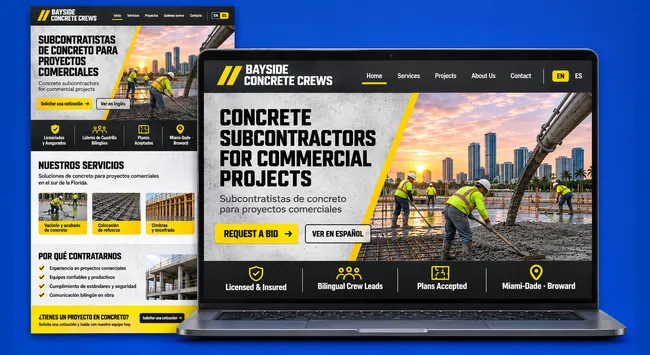
Bilingual Contractor Website: What to Translate and What to Leave in English
A bilingual contractor website translates what customers and crews read and keeps in English the terms a general contractor uses, such as bid, COI and license category names. SENAVIA builds these sites in South Florida with one address per language, written in Florida Spanish.
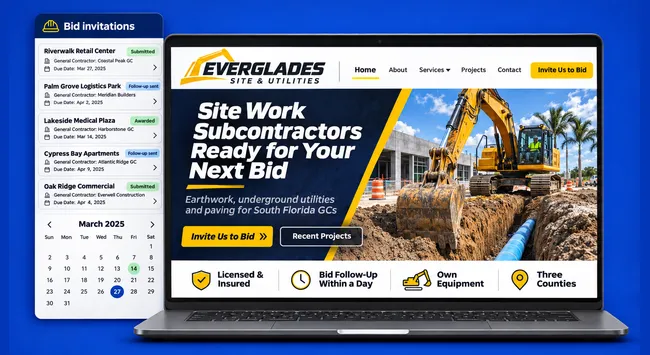
How subcontractors get more bid invitations online
To get more bid invitations, a South Florida subcontractor needs to be easy to find and easy to vet: a website that answers the general contractor's checklist, matching platform profiles, a Google Business Profile with honest reviews and follow-up on unanswered bids. SENAVIA maps each piece without promising results.
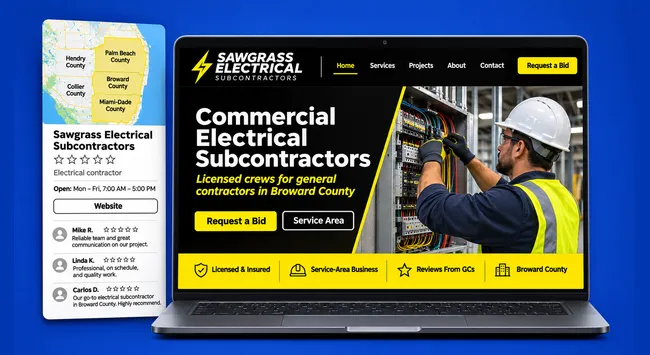
Google Business Profile for subcontractors: category, service area by county and reviews
A Google Business Profile for contractors needs one specific trade category, a service area that names the places you work, photos of finished jobs and reviews asked for without incentives. SENAVIA explains how a general contractor sees it in Maps and what must match your South Florida website.
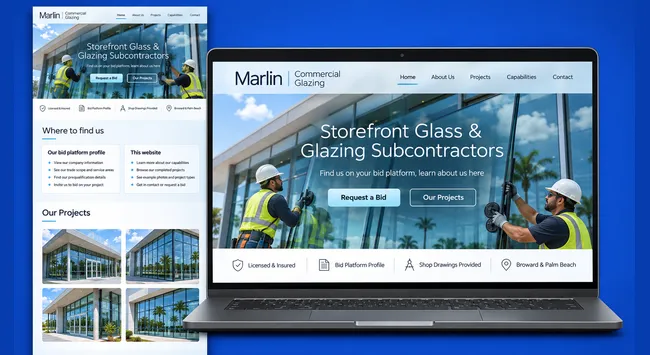
Do Subcontractors Need a Website If They Are Already on PlanHub, BuildingConnected or The Blue Book?
Do subcontractors need a website if they already have a PlanHub or BuildingConnected profile? Usually yes: a profile shows what the platform lists, while your own site can show license, insurance, finished jobs and a plans form. SENAVIA builds those sites for South Florida subcontractors.
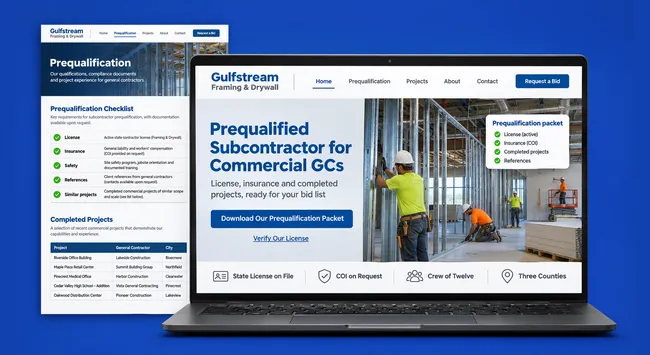
What general contractors look for in a subcontractor before inviting them to bid (and where your website should answer it)
A subcontractor prequalification checklist in South Florida covers an active license in the right category, a certificate of insurance, similar past work, crew and county coverage, and a way to send plans. SENAVIA shows where your website should answer each one.
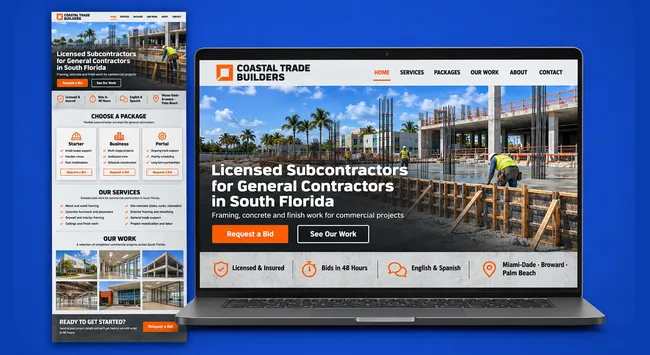
How Much Does a Subcontractor Website Cost in South Florida? Published Starting Prices
A subcontractor website cost in South Florida starts at $650 for a Landing Page, $1,750 for Corporate Business and $3,750 for Lead Generation, with a $9,475 portal when you need logins. SENAVIA publishes every starting price and timeline, unlike the anonymous ranges you find elsewhere.
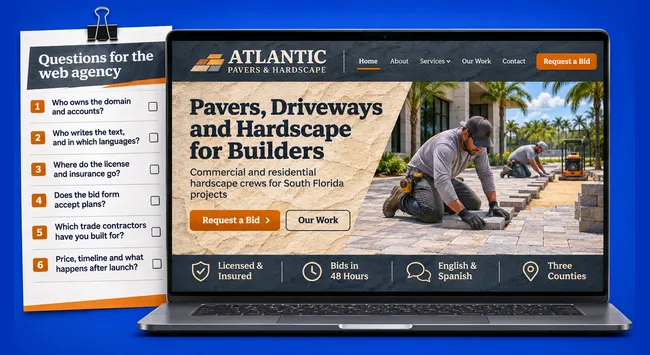
Questions to Ask a Web Design Agency Before You Hire One (for Subcontractors)
The questions to ask a web design agency as a subcontractor cover who owns the domain and accounts, who writes the text, how the license and insurance appear, how plans reach the estimator, past trade work, and price. SENAVIA answers each for South Florida with published facts.
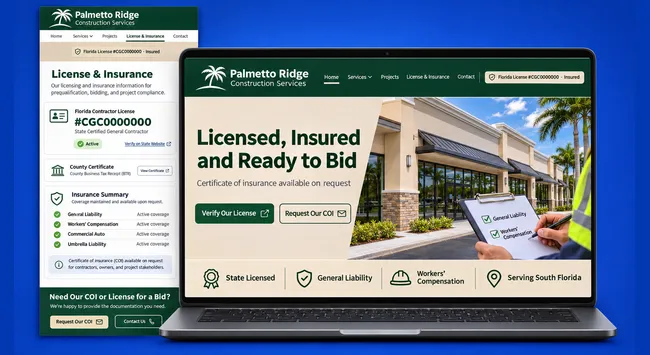
Your contractor license number on a website in Florida: what the statute says and where to put it
Under Florida contractor advertising rules, F.S. 489.119(5)(b), a contractor license number "shall appear in each offer of services, business proposal, bid, contract, or advertisement, regardless of medium," and a website that offers services usually counts. SENAVIA explains where to place the license number on website pages in South Florida.
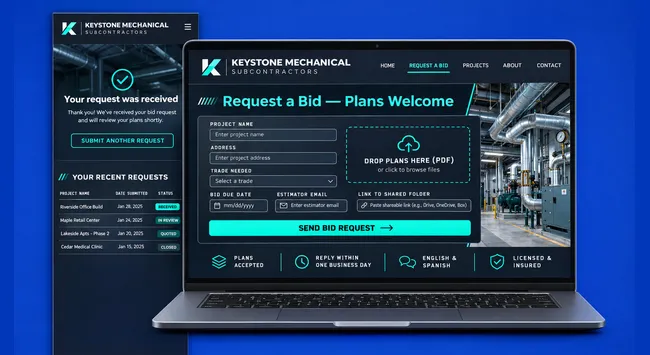
Bid Request Form That Accepts Plans: How to Put One on Your Own Website
A bid request form on a subcontractor's own website should ask for the project, address, trade, due date, contact and plans, then alert the estimator and keep a record. SENAVIA builds that form for South Florida subcontractors, in English and Spanish, working on phones too.
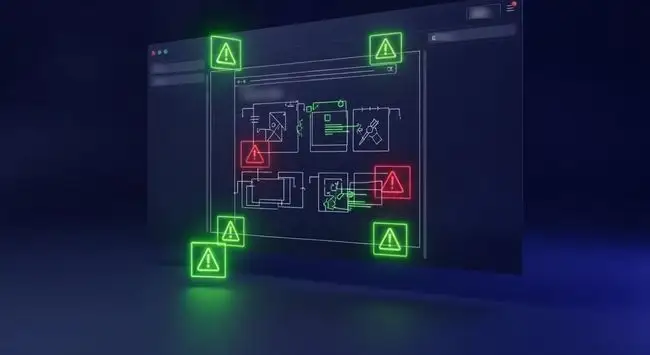
10 Website Design Mistakes That Drive Customers Away
The website design mistakes that drive customers away are the ones that slow down or confuse a buyer: slow mobile pages, unclear headlines, hidden contact details, cluttered layouts, weak calls to action, hard-to-read text, pushy pop-ups and long forms. Each one has a specific, testable fix.

Perplexity AEO: How to Get Cited in Perplexity Answers in 2026
Perplexity AEO is the work of making your pages easy for Perplexity to find, trust and cite. Perplexity searches the web in real time and footnotes each answer, so it rewards crawlable pages that answer one question clearly, name a real author and back every claim with a source.

Webflow CMS Setup: How to Build Collections Without Code
A Webflow CMS setup starts with a content model: one Collection per type of content, the fields each item needs, a Collection template page that designs every item at once, and Collection lists wherever items should appear. None of it needs code, only a clear structure planned before you build.

Webflow Core Web Vitals: How to Pass LCP, INP and CLS
Webflow Core Web Vitals are Google's three field metrics, LCP, INP and CLS, measured on real visits to your Webflow site. You pass them by serving a light hero image early, reserving space for anything that loads late, and trimming the third-party scripts that delay taps and clicks.
Custom Website Design Benefits for South Florida Small Businesses
The main custom website design benefits are speed, a structure search engines understand, accessibility and ownership. A site planned around your services, customers and South Florida market loads faster on phones, answers the questions buyers ask, turns more visits into calls and grows with the business instead of fighting a template.

E-E-A-T for AI Search: How to Build Authority AI Engines Trust
E-E-A-T for AI search means showing experience, expertise, authoritativeness and trust in ways both readers and AI engines can verify. Google says it is not a single ranking factor, but its systems look for content that shows these qualities, and trust matters most.

AI Overviews SEO Strategy: What Changes in 2026 and What Stays
An AI Overviews SEO strategy keeps the fundamentals Google still ranks on, then adds what AI answers reward: pages that settle specific questions, cover related sub-questions, show who wrote them and turn fewer but better clicks into leads, measured in Search Console.

Full-Stack Development with React and Node.js: From Zero to Production
Full-stack development with React and Node.js means one language, TypeScript, across the interface and the API. To reach production safely, agree on the API contract first, validate every input on the server, keep sessions in secure cookies, test the critical user journeys end to end, and deploy each part where it runs well.

Benefits of Responsive Web Design for South Florida Businesses
The main benefits of responsive web design are that one site works on every screen, Google indexes the mobile version you actually designed, visitors can read and tap without zooming, and you maintain a single set of pages. For South Florida businesses whose customers search on phones, it often decides whether they call or move on.

How Web Design Affects Local SEO for South Florida Businesses
How web design affects local SEO comes down to what Google can read and what visitors do: clear pages for each service and area, a consistent name, address and phone, fast mobile pages, LocalBusiness structured data and calls to action that turn local searches into calls. A careless redesign can undo all of it.

How to Convert Website Visitors into Customers: A 2026 Guide
To convert website visitors into customers, match each page to what the visitor searched for, state the offer in plain words, ask for one clear action, show proof a stranger can check, keep forms short, reply fast and measure every call, form and booking as a key event.

How to Get Cited by ChatGPT: A Content Playbook for 2026
To get cited by ChatGPT, let OpenAI's search crawler reach your pages, answer specific questions in the first lines of each page, back claims with linked sources and make your business easy to verify. ChatGPT cites pages it can retrieve and quote with confidence.

AEO Keyword Research: How to Find the Questions AI Answers
AEO keyword research means finding the questions your buyers ask search engines and AI assistants, then deciding which page answers each one. Start from Search Console queries, related questions in search results and your sales calls, and group them by intent before you write.

SEO Lead Generation Funnel: From First Search to Signed Client
An SEO lead generation funnel turns search visibility into inquiries in stages: helpful content and AI-ready answers bring people in, comparison and proof pages earn their trust, and focused landing pages, local listings and fast follow-up convert that intent into booked calls.

React Performance Optimization: How to Cut Load Time in 2026
React performance optimization starts with measuring real users, then shipping less JavaScript: split code by route, move data work into Server Components, let React Compiler handle memoization, and prioritize the main image and fonts. Those steps usually matter more than fine-tuning individual components.
Webflow Responsive Design: Breakpoints, Grid and Flexbox
Webflow responsive design runs on breakpoints that cascade: styles on the desktop base flow down to tablet and phones unless you override them, and the larger breakpoints inherit upward. Build layouts with Flexbox or Grid in relative units, then adjust only what actually breaks at each size.

REST vs GraphQL: Which API Fits Your Custom Application?
REST vs GraphQL is a choice about who shapes the data. REST exposes fixed resources over standard HTTP, which keeps caching, webhooks and public integrations simple. GraphQL lets each client request exactly the fields it needs from one typed schema, which suits products with several front ends and deeply related data.

AWS vs Heroku vs Vercel: Where to Deploy a Web App in 2026
Heroku vs Vercel comes down to the shape of your app. Vercel suits React and Next.js front ends with short-lived serverless functions. Heroku suits always-on servers and background workers, but it stopped adding new features in 2026. AWS suits teams that need full control and can staff the operations work.

Scalable Application Architecture: How to Design Web Apps That Grow
Scalable application architecture is a way of building a web app so it handles more users, more data and more developers by adding capacity, not by rewriting it. In practice: start with a modular monolith, keep servers stateless, protect the database with caching and queues, and measure before you split anything.

Webflow Animations That Convert: Motion With a Purpose
Webflow animations convert when they explain something: feedback on a click, a cue that a section continues, attention drawn to the next step. Build them with Webflow Interactions, animate only transform and opacity, honor reduced-motion settings and drop any motion that delays content or the call to action.

10 Webflow SEO Mistakes That Hurt Rankings and How to Fix Them
Most Webflow SEO mistakes are configuration gaps, not platform limits: an indexable staging subdomain, CMS templates with empty titles and descriptions, missing redirects after a redesign, images without alt text and no structured data. Each is quick to fix once you know where Webflow keeps the setting.

Why Your Website Isn't Generating Leads and 7 Fixes That Work
A website is not generating leads when one link in the chain breaks: the wrong visitors arrive, the page hides the offer, nothing proves you are trustworthy, the form or phone path has friction, or nobody follows up quickly. Measure each step, find the weakest link and fix that one first.
Ready to Put These Tips Into Practice?
Schedule a 30-minute consultation and let's design a digital strategy worth talking about.
Book a Free Call (954) 706-4084