Some trades leave a general contractor (GC) with no state license to look up, and that changes what the website has to prove. SENAVIA, a web design agency in Plantation, wrote this guide on what a drywall and painting subcontractor website can show in place of a license number. It is practical guidance, not legal advice.
Do drywall and painting need a state license in Florida?
Usually not, but check the scope. The DBPR's list of services requiring a license places painting among work that needs no DBPR license, and drywall too, provided the contract adds no load-bearing wall, plumbing, electrical or air-conditioning work. A county or city can still ask for its own license or registration.
The drywall entry deserves a second read. The same list says a contract that also covers work on the load-bearing part of a wall, or plumbing, electrical or air conditioning, does need a license. A company that only hangs and finishes board sits on one side of that line; one that bundles other trades may sit on the other.
The state's construction industry FAQ also lists paint among examples of work that needs no state licensure, and the list page itself tells you to check with your county or city about a local business tax receipt or certificate of competency. In Miami-Dade, the Construction Trades Qualifying Board page names the county's license types (Building, Building Specialties, Electrical, Maintenance, Mechanical and Plumbing) and does not mention drywall or painting. Ask the county's licensing section whether your scope falls under any of them before you write about it.
Our pages for Hialeah, where drywall subs ask this question, and Coral Springs, for painters, show how the same facts read for a GC in each city.
What does a general contractor check when there is no state license to verify?
A GC usually moves its checks to what it can still confirm: a certificate of insurance (COI) showing general liability and workers' compensation, finished jobs like the one being bid, the size of the crew and what it can take on, and what other GCs say about the company.
- COI and workers' comp. List your coverages and offer the current certificate on request. With no license number to read, the certificate is often the first document a GC asks for.
- Similar jobs, with photos. A hotel corridor, an office suite and a house are different work. Show the kind the estimator is pricing.
- Crew and capacity. Say how much space a crew usually handles at once and which counties you cover, without promising more than you can staff.
- GC references. Names only with permission. Ask the contractors you worked for whether they will take a call.
- Punctuality. A site cannot prove a crew arrives on time, but quick replies to bid requests and references that mention schedule point to it.
Everything else a GC looks at before plans go out is in what a GC reviews before sending a sub the plans. Where the insurance details sit, and what the statute says about a license number, is in showing your license number and insurance online in Florida. For the wider picture, see our guide to websites for subcontractors.
How do you show the finish in photos?
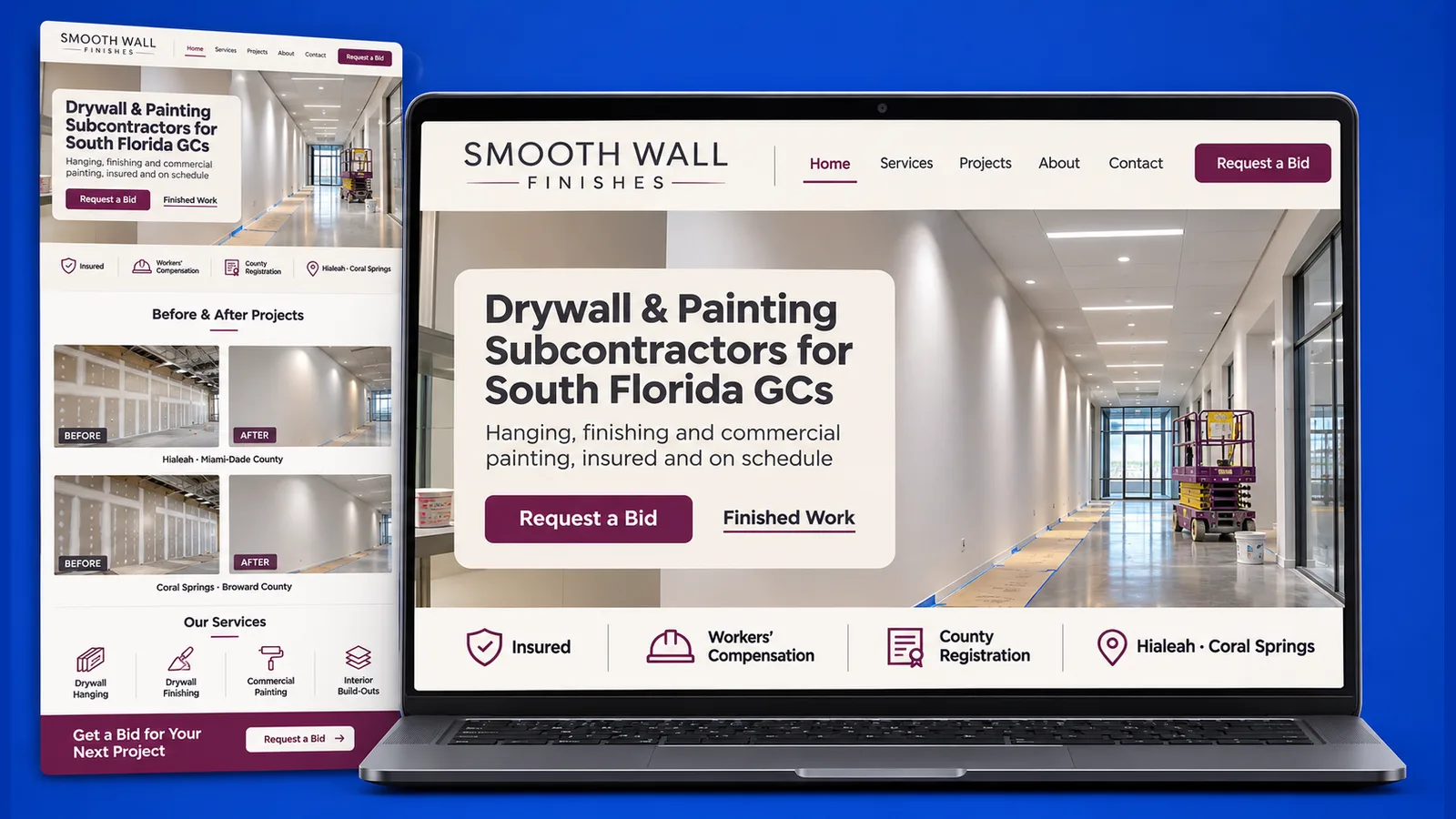
Show the finish itself: a before and after of the same wall, a close detail of joints and corners, and daylight instead of a flash, each with a caption that names the city. A GC cannot feel a wall through a screen, so the photograph has to carry the quality.
- Before and after. Same spot, same angle, same distance. A shot from a different place proves nothing, and an estimator notices.
- Joints and corners. Drywall is judged where boards meet and walls turn, painting where color stops at trim or ceiling. Close shots of those places say more than a wide room.
- Natural light. Window light falling across a wall shows the surface as it is, so a photo that looks good in it is a fair one. Keep tools, ladders and drop cloths out of the frame.
- A caption with the city. Scope, kind of building, city and county, such as "Corridor drywall repair and repaint, Hialeah, Miami-Dade County." Leave out street addresses and personal belongings.
Ask the GC or the owner before you post a finished job, and skip the contractor's name unless it agrees to appear. Choosing, sorting and publishing photographs is covered in project photos that win bids.
If you have finished work but no photographs you would show a GC, book a free 30-minute call and bring what you have; we will plan what to shoot next.
Which pages does a drywall and painting subcontractor website need?
A drywall and painting subcontractor website needs these pages: home, drywall, painting, a gallery, insurance and local registrations, a quote form that takes plans, and a Spanish version. They follow the order in which an estimator usually reads.
- Home. Who you are, your trades, the counties you cover and a request-a-quote button on the first screen.
- Drywall. Hanging, taping and finishing, repairs after other trades and the buildings you work in. Say what your contracts include.
- Painting. Interior and exterior work, the buildings you paint and whether you work in occupied or vacant spaces.
- Gallery. Finished jobs sorted by trade and building type, with captions.
- Insurance and local registrations. Your coverages, how to request the COI and any county or city license or registration that fits your scope.
- Quote form that takes plans. The job name, location, due date and an attachment field for plans, sent to whoever prices the work and easy to fill in on a cell phone.
- Spanish. The same pages in Spanish, since many crews and some customers work in that language.
Separate pages let a search for one trade land on a page about it, and let a company that does both present the pairing as a strength.
How much does it cost, and how long does it take?
The published packages run from a Landing Page at $650 (1 month) to the Corporate Portal Suite at $9,475 (3.5 months), with Corporate Business at $1,750 (2 months) and Lead Generation at $3,750 (3 months) between them. Each is a starting price; see the pricing page.
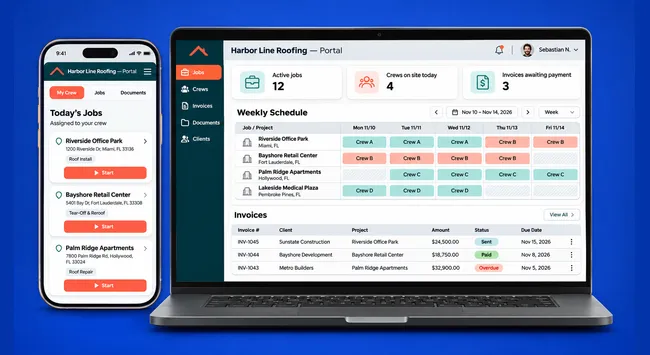
A company that wants a page per trade, a gallery and an insurance page usually fits Corporate Business. A single page with the trades, the counties and a phone number fits the Landing Page. Lead Generation suits a company running ads with a page for each city, and the Portal is for crews and customers who log in. Scope is fixed in the written quote.
The Spanish version is a listed add-on without a price of its own, so it is quoted with the rest. What moves a price is explained in subcontractor website pricing explained, and our business website design service covers the Landing Page and Corporate Business packages.
For the Spanish version of each page, see what to translate and what to leave in English in our guide to a site in Spanish and English.
Drywall and painting close the series. For trades with a state license, see the roofing version of this guide, what an electrical contractor’s site needs and HVAC subcontractor site, step by step: the photo and insurance advice carries over; the license section does not.
Frequently asked questions
Should the site say that no state license applies to the company?
Better to describe what you do and where to verify it than to announce an absence. State your trades and scope, point to the DBPR list for readers who want to check, and show the insurance and any local registration you hold. If you are unsure which rule fits a contract, ask the DBPR or an attorney before publishing a statement.
What if the same contract includes framing or electrical patching?
Then the drywall entry on the DBPR list may no longer fit, because it separates drywall alone from drywall bundled with other work. Read the entry against your contract and, if you hold a license, show it as described in the guide linked above.
Does a painting company need separate pages for interior and exterior work?
It helps when the two have different buyers or photographs. Interior repaints are often bid inside a larger renovation, while exterior work is judged on the building from the street. Start with one painting page in two sections and split it when each has enough finished jobs.
Ready to plan these pages with a team that knows what a GC looks for? Book a free 30-minute call with SENAVIA.