What does a subcontractor website include at $650, $1,750 and $3,750?
SENAVIA lists its starting prices on its web design pricing page: Landing Page from $650, Corporate Business from $1,750 and Lead Generation from $3,750. Each step adds pages and tools that help a trade company get invited to bid. They are starting prices, so the final quote depends on your trades, counties and languages.
Anyone searching for a subcontractor website cost usually lands on anonymous ranges with no hint of what sits inside each number. Here is what each package covers.
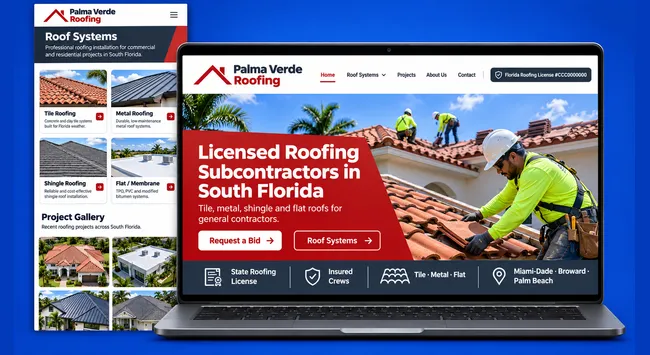
Landing Page, from $650. One page built to look credible the moment an estimator opens it. It works on a phone, carries call and WhatsApp buttons, and lays out your services, testimonials and common questions. It is set up to be found on Google when someone searches your company name, and hosting, domain and security are handled for you. It suits a small crew that mainly needs to look legitimate and be easy to reach. It is not designed to give every trade its own page.
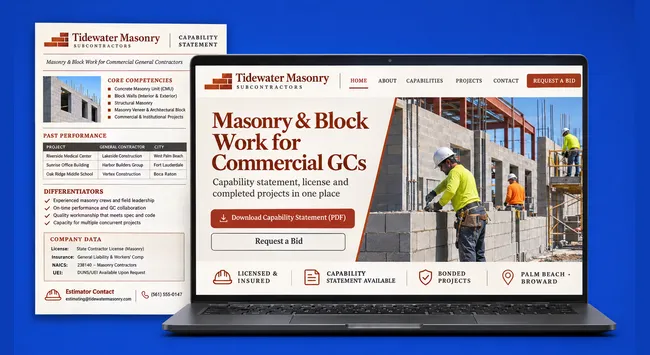
Corporate Business, from $1,750. Up to ten pages that you can edit yourself, with a page for each service, a blog, online appointment booking and a tuned Google Business Profile. For a subcontractor this usually means one page per trade, a company page where the license and insurance details live, and room for finished jobs. A bilingual English and Spanish version is listed as an add-on to this package.
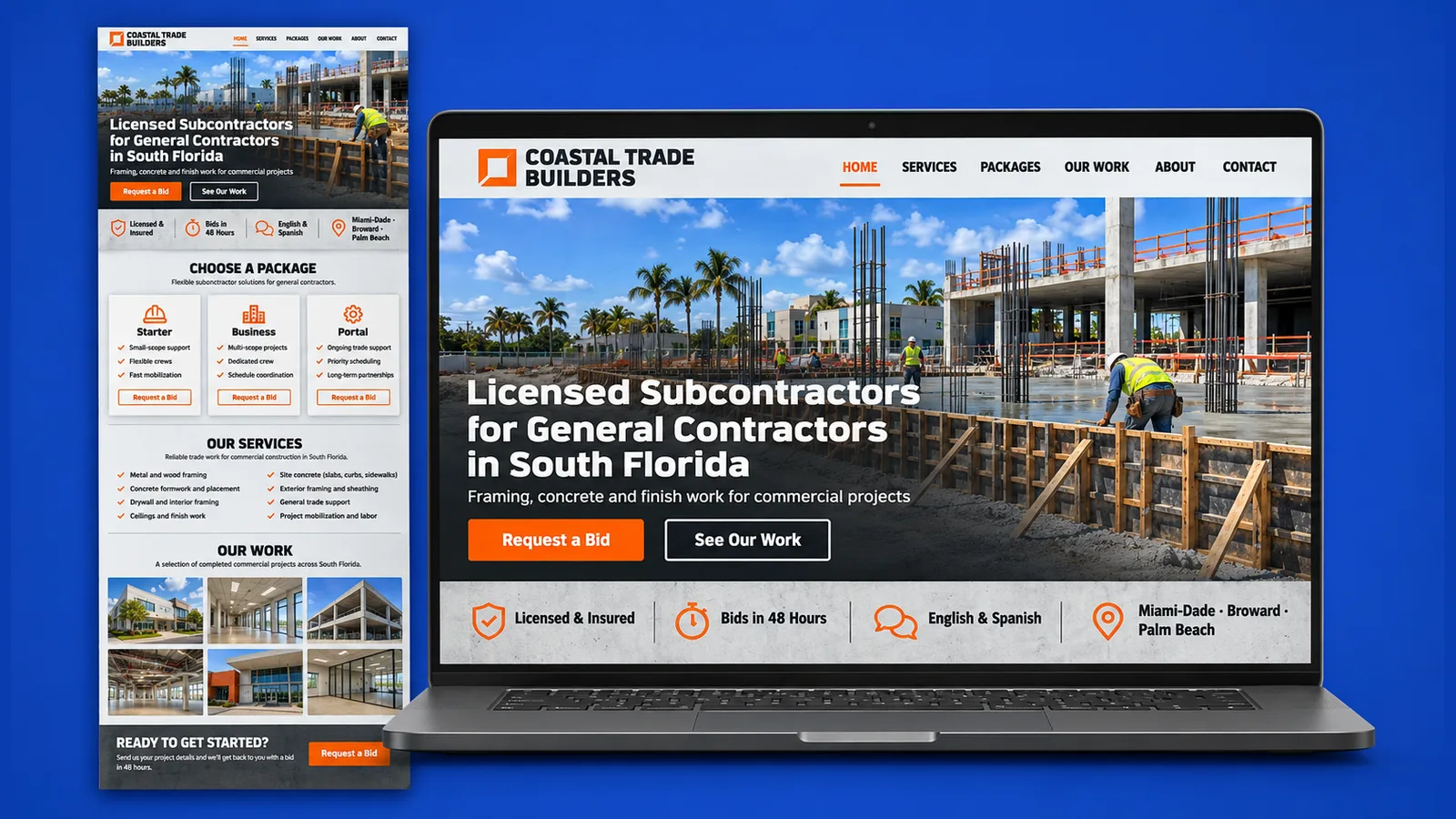
Lead Generation, from $3,750. A page for each service, prepared to receive visitors from Google and Meta ads, plus pages for each city you serve, deeper search work, forms made to capture contact details, online booking and tracking that shows which ad and which page produced each call. It fits a subcontractor who wants a general contractor (GC) or property manager to land on a page that matches the exact trade and area.
Want a number for your own trade before reading further? The online website cost estimator gives a first range in a few minutes. If you would rather talk it through, you can book a free 30-minute call and we will go over it together.
When does a subcontractor need a portal ($9,475), and when not?
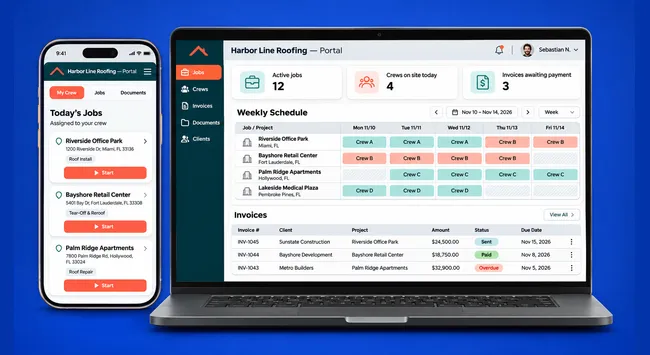
A portal is a site where people sign in and see private information. SENAVIA's Corporate Portal Suite starts at $9,475, according to the same pricing page. A subcontractor who only wants more invitations to bid usually does not need one. It earns its place once you are running crews, jobs and invoices from spreadsheets and text messages.
The portal package describes separate sign-ins for your clients and your team, where each person sees only what belongs to them, whether admin, client or employee. It adds a private dashboard for records and tracking, a link to the CRM or system you already use, a private library of resources and up to 25 pages that you manage yourself.
Think of it as a second project behind the website. If the goal is to be found, checked and invited, start with one of the three site packages. If the pain is chasing crew leads for photos, tracking change orders or knowing which job has been paid, a portal starts to make sense. Our page on subcontractor website design in South Florida shows how the two pieces fit together.
How long does each package take?
According to SENAVIA's pricing page, a Landing Page takes 1 month, Corporate Business takes 2 months, Lead Generation takes 3 months and the Corporate Portal Suite takes 3.5 months. How quickly you send photos, logos and license details usually moves the real date more than anything else.
Time is also a cost. A bid season does not wait for a website, so a smaller package that goes live sooner can be the practical choice. A custom request, such as an unusual integration, is quoted separately, and the date is agreed in writing then.
What makes a subcontractor site cost more, and what does not?
Scope moves the price: how many pages, how many languages, how much has to happen behind a form and whether anyone signs in. Showing your license, your insurance and text you already wrote is content, not engineering, so it does not push the number up.
These choices usually add cost:
- A separate page for each trade or scope, so that a roofing, electrical or drywall search lands on the right one.
- City or county pages for every area you cover.
- An English and Spanish version of the whole site.
- A bid form that accepts plan files and deadlines and routes each request to your estimator.
- A gallery of finished jobs sorted by type, with a caption that states the scope.
- Connections to a CRM, payments or accounting, which belong to the portal level.
These usually do not change the price: putting your license number where a GC will look, showing a COI (certificate of insurance, the document from your insurer that proves coverage), and reusing wording you already have. If you are comparing agencies, ask what exactly is behind each line of the quote. Our business website design service explains how those pages are built.
Location matters less than the pages needed to cover it. Here is how we approach web design for businesses in Miami and web design for businesses in Davie.
What should the price of a subcontractor website include?
A quote for a trade company should name five things: license and insurance shown where a GC looks, a bid request form that takes plans, a gallery by job type, English and Spanish, and Google accounts connected and ready to advertise. A bid is the price you offer for a scope of work.
In detail, a quote worth accepting should say how each item is delivered:
- License and insurance, visible. The state license number and a clear note on coverage, easy to find on the first visit instead of buried in a PDF.
- A quote request form that takes plans. A form that accepts drawings and due dates, so a GC does not need to email back and forth.
- A gallery by type of work. Commercial, residential, new construction and remodel kept apart, each with a short caption.
- English and Spanish. Clarify whether both languages are in the price or an add-on, and who writes the Spanish.
- Google accounts, connected. The pages SENAVIA builds are meant to capture leads, and they are delivered with the Google accounts linked so a subcontractor can start advertising when ready. We do not promise any result from that advertising.
What else should you know about subcontractor website cost?
Can I pay for the website in parts?
The published prices are starting prices for each package. They do not describe an installment plan, so payment timing is set in the written quote after a conversation about your project. Ask for the schedule in writing before work begins.
Does the price include Spanish?
The Corporate Business package lists a bilingual English and Spanish site as an add-on, and the pricing page gives no separate figure for it. We quote it with the rest of your project. If most of your crew or your suppliers work in Spanish, say so early so it can be planned from the first page.
What about maintenance?
The pricing page lists no maintenance fee, so this article gives no figure for it. The Landing Page package does list hosting, domain and security as handled for you. Ask for anything beyond that to be itemized.
The fastest way to turn these starting prices into your own number is the website cost estimator. If you prefer to talk, book a free 30-minute call and we will go through your trades, counties and languages together.