What do you translate on a bilingual contractor website, and what do you leave in English?
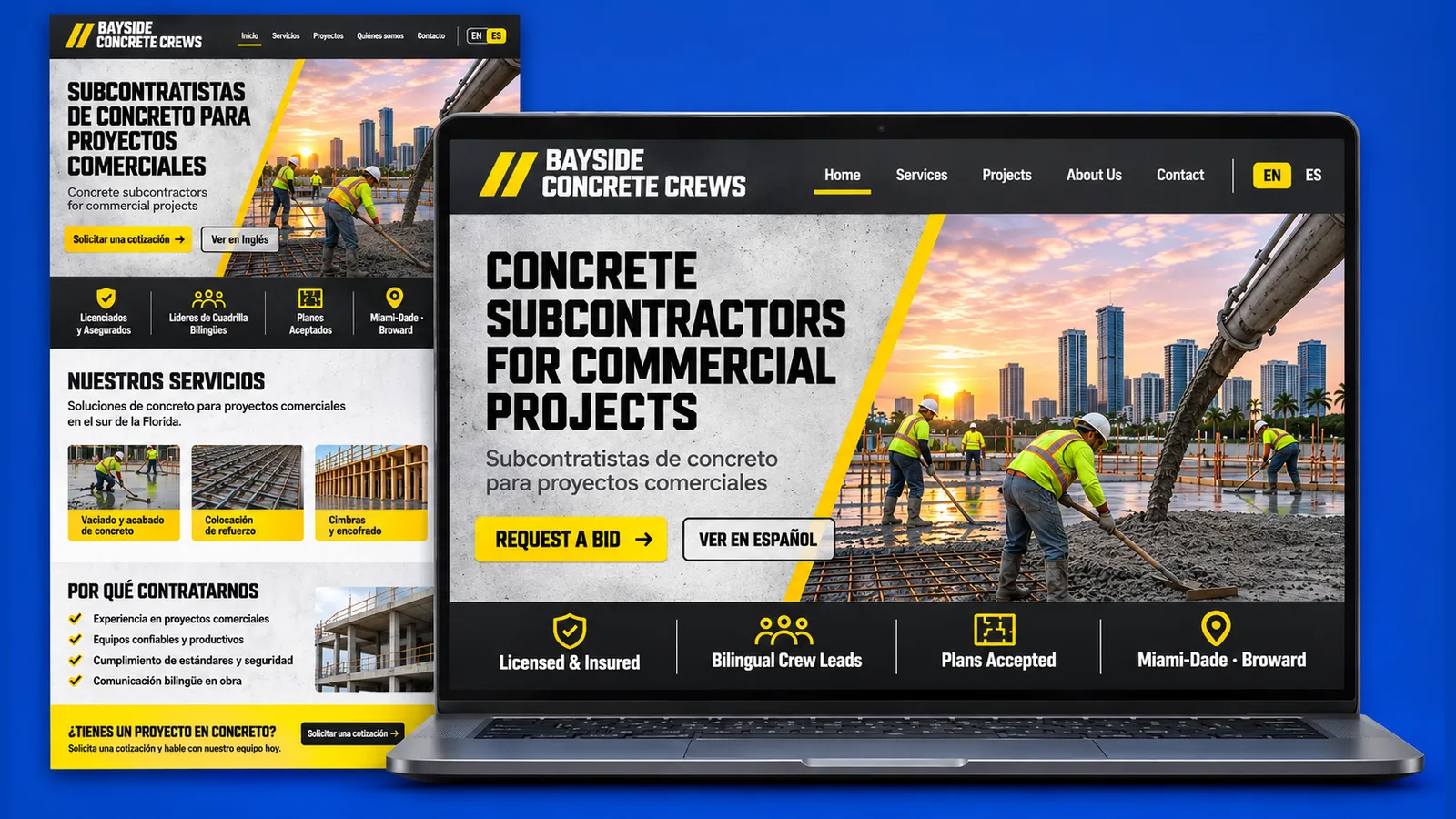
Translate what the customer and the crew read: your services, how to reach you and what the work involves. Leave in English the terms a general contractor (GC) already uses: bid, COI, the names of the license categories, agency names such as the DBPR, and each trade exactly as the permit prints it.
A GC usually opens a contractor's site with a mental checklist written in English. If the page says "constancia de seguro" where the checklist says COI, the reader has to stop and translate. So the Spanish version keeps the English term and explains it once, in plain words: a bid is your price for a defined piece of work, and a COI is the certificate of insurance your insurer issues.
Florida issues the state license in two kinds, registered and certified, and both words stay in English on both versions of the site. According to the DBPR construction industry FAQ, a registered license lets you practice only in the county or city that issued your local license, plus adjoining places that accept the registration, while a certified license lets you work throughout the state. Use "certified" only in that sense, never as a compliment about your quality, and copy the category exactly as your license record prints it. Where the number itself goes is covered in our guide to where license and insurance details belong on a Florida contractor site.
What does get translated is everything a person has to understand to hire or work with you:
- The description of each service and what a typical job involves.
- The labels of the bid request form and the message shown after it is sent.
- The page about your crew, your hours and the cities you cover.
- The invitation to call, text or write, with the same phone number and email on both versions.
Keep one line with the trade name as the permit prints it, and write the Spanish explanation around it. Our page on how SENAVIA builds sites for subcontractors in South Florida shows where that line sits among the rest of the credentials.
Florida Spanish or Spain Spanish?
Write in the Spanish your readers speak here. Address them as "usted", and say "sitio web", "cotización", "celular", "licencia", "seguro" and "cuadrilla". Spanish written for Spain reads like a page from somewhere else, and a reader who feels that distance can trust the company a little less.
These are the pairs that come up most on a contractor site, with the Florida choice first:
- "Cotización", not "presupuesto", for the price you give for a job.
- "Celular", not "móvil", for the phone in your pocket.
- "Archivo", not "fichero", for the plan a GC uploads.
- "Llene el formulario", not "rellene", for the bid request form.
- "Estacionamiento" and "auto", not "aparcamiento" and "coche".
- "Computadora", not "ordenador", and "haga clic", not "pinche".
Place names keep their official spelling, so Boca Raton has no accent on the second word. Measurements follow the plans a Florida crew reads, which means feet and miles, not meters and kilometers.
The Spanish page is not a word-for-word copy of the English one. The English page talks to an estimator who wants a license, a COI and a deadline. The Spanish page can talk to a crew lead who wants to know how the company works with its people. The facts are identical; the order and the tone are not.
One URL per language, or a language selector?
Give each language its own URL and tie the pair together with hreflang, so each page names its twin. On this site, /service-areas/hialeah-fl has a Spanish twin at /es/service-areas/hialeah-fl, and each one points to the other. That annotation is how a page declares the language it is written in and where its counterpart lives.
A link is something people send: a GC can forward the English address to an owner, and a crew lead can text the Spanish one to a cousin who needs a roofer. A button that swaps the words on a single address leaves one address holding two languages, and nobody can point a reader to the version they need.
A visible switch is still useful, as long as it jumps to the twin page instead of rewriting the current one. Look at how the Hialeah page for subcontractors and the Davie page for subcontractors are built: same structure, same facts, one address per language.
Seeing how your own site would read to a GC is a good first step. To walk through it page by page together, book a free 30-minute call.
Who reads each version?
The GC and the estimator usually read the English version, so it carries the license, the COI, the bid request form and the finished jobs. The crew and the suppliers tend to read the Spanish version. The end customer depends on the neighborhood, one block Spanish and the next English, so each version has to stand on its own.
Think of three readers and give each one a reason to stay:
- The GC and estimator can decide in a short visit whether to invite you to bid, so the credentials and the way to send plans must be easy to find.
- The crew and the suppliers are often the people who recommend a company to a GC or a homeowner, and they need to understand what you do and how to reach you without asking someone to translate.
- The owner or property manager usually wants to know the scope, the area you cover and whether you answer a call, in whichever language they speak at home.
Both versions must carry the same license number, phone number, address and trade list. If the English page says one thing and the Spanish page says another, a careful GC can notice. That consistency is the real work of a bilingual site, more than the translation itself.
How much does it cost to add Spanish?
In SENAVIA's pricing, a bilingual English and Spanish version is an add-on of Corporate Business. No figure is published for it, so it is quoted together with the rest of your project. Our subcontractor website cost guide covers the starting prices of the packages.
What moves a quote for the Spanish side is easy to ask about. Who writes it: a person who knows Florida Spanish, or a machine pass that someone reads afterwards? How many pages are involved? Who updates the Spanish when you add a project to the gallery? An agency that answers those in writing is easier to compare.
The pages are part of our business website design service, and everything we build is on our web design page.
Who writes the Spanish is one of the questions to ask a web design agency before you hire one; ask it before the quote, not after launch.
What else do contractors ask about a bilingual site?
Should the license line be translated?
Leave the number and the category name exactly as the license record prints them, then add a short Spanish explanation beside it. That way the reader who knows only the Spanish can follow it, and a GC checking the record finds a match character for character.
Who keeps the two versions in step after launch?
Someone has to own that, and it is better to decide before launch. When you add a finished job or change a phone number, both versions should change the same day. Ask the agency whether a change to one page prompts a change to its twin, or whether you do it by hand.
Can I start with one language and add the other later?
Yes, if the first version is built so the second can sit beside it with its own addresses. Retrofitting a language onto a site made for one is usually harder than planning the twin pages from the first day.
To see how this would work for your trade and your counties, book a free 30-minute call, with the site you have today open.