Roofing work is hard to judge from a phone call, so the paperwork and the photographs carry the first impression. A roofing subcontractor website has to give a general contractor (GC) both in one visit. This guide covers the license to show, the roof systems to build pages around and the photos a GC looks for. SENAVIA, a Plantation web design agency, wrote it as practical guidance, not legal advice.
What license does a roofer need in Florida, and how does the website show it?
Roofing is among the categories that require state registration or certification, says the DBPR construction industry FAQ. A certified license works across the whole state; a registered one is tied to a county or city and any adjoining places that accept it. Show which you hold, with the number.
The Construction Industry Licensing Board's construction industry page lists "roofing contractor" among its license types and describes that contractor as one whose services are unlimited in the roofing trade. Copy the number, the category and the business name exactly as the record prints them.
The same FAQ says roofing work cannot be subcontracted to unlicensed roofers, so a GC may want to confirm the license is yours. The state's online services page lists Verify a License for that, and your license page should link to it. Where the number goes, and what the statute says about advertising, is in our guide to where to show the license and insurance on a Florida contractor website.
If you belong to the Florida Roofing and Sheet Metal Contractors Association, say so on that page. The association's own site describes its purpose as encouraging a high standard of business ethics among its members. State your membership as a fact and let the reader draw the conclusion.
What does a general contractor look for on a roofing subcontractor's website?
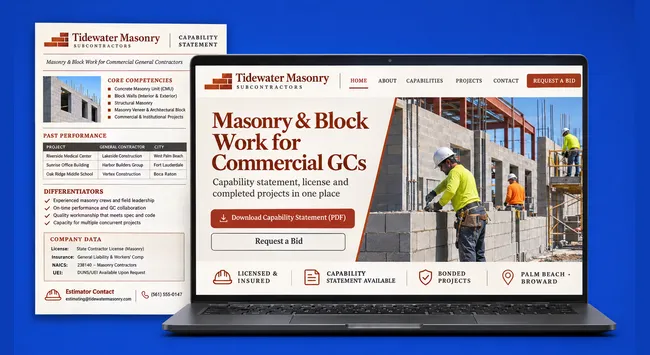
A GC usually looks for an active license, a certificate of insurance (COI) it can request, finished roofs that resemble the job, the systems you install, the counties you cover and whether your crew can take the work. Each answer should be findable without a phone call.
- COI on request. Say which coverage you carry and that a current certificate is sent when asked.
- Roof systems. Tile, metal, membrane and shingle are different jobs with different materials, so name the ones you actually install instead of promising every type of roof.
- Finished roofs. Work of the same kind as the bid on the estimator's desk, with its location and scope.
- Counties. List the counties and cities you take work in. A roofer near Homestead, at the south end of Miami-Dade, and one in Aventura start from different places, and a GC usually notices. Our Aventura page already answers the roofing question for that city.
- Crew. Say what size of job your crew handles and whether it works in Spanish as well as English. Do not promise capacity you cannot staff.
The full review a GC runs before sending plans is in our guide to subcontractor websites. For roofing, the extra weight falls on systems and photographs, where generic sites are thin.
Which pages does a roofing subcontractor website need?
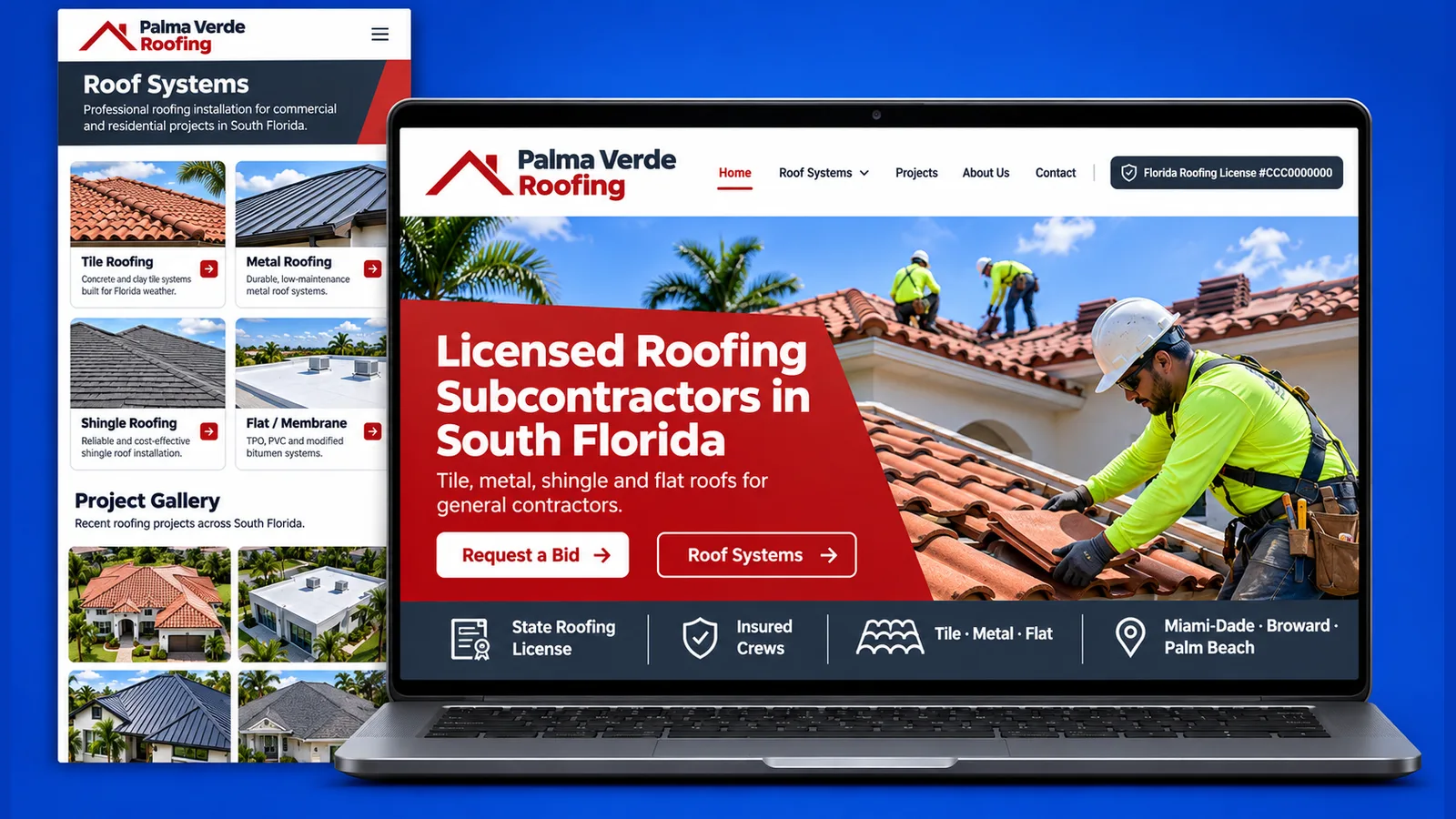
A roofing subcontractor website needs a home page, one page per roof system, a gallery by type, a license and insurance page, a quote form that accepts plans and a Spanish version. In that order, they cover what an estimator usually checks.
- Home. Who you are, the systems you install, the counties you cover, plus the license and a request-a-quote button in the first screen.
- One page per roof system. Tile, metal, membrane and shingle each get a page with what you install, the buildings you do it on and a few finished roofs.
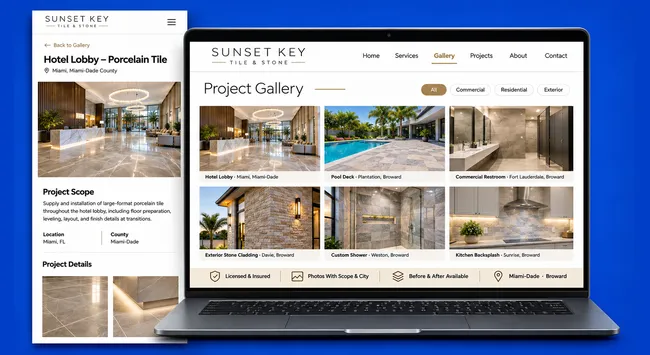
- Gallery by type. Finished roofs sorted by system or building, with captions. See how project photos win bids.
- License and insurance. The number and category, the Verify a License link, the coverage you carry and how to request the COI.
- Quote form that takes plans. Project name, address, bid due date and a file upload, routed to whoever prices the work.
- Spanish version. The same pages in Spanish, because many roofing crews and their customers work in that language.
Splitting by roof system also helps a search for a metal roof installer land on a page about metal roofs, not on a home page that mentions it once.
If your site today is a single page or a template, book a free 30-minute call to mark which of these pages you already have.
What photos and captions convince a general contractor in roofing?
The photos that usually persuade a GC show a finished roof from above or from the street, plus a close look at flashings and edges, each with a caption giving scope, city and county. Leave the GC's name out unless it has agreed to appear.
Shoot when the roof is clean and the light is even, and keep tools, debris and trucks out of frame. A detail of a valley or an edge tells an estimator the crew cares about parts the owner never sees. For a repair, a before and after of the same spot shows the scope better than a wide shot.
Write each caption as a small answer: system, kind of work, kind of building, city and county. For example: "Tile re-roof, commercial building, Miami Gardens, Miami-Dade County." Skip street addresses, and ask the GC or the owner before posting a job done for them.
A Florida contractor shows the same habit: GQM is a licensed general and roofing contractor, and its site lists completed projects with their location and scope, in English and Spanish.
How much does a roofing subcontractor website cost, and how long does it take?
SENAVIA's starting prices are Landing Page from $650 in 1 month, Corporate Business from $1,750 in 2 months, Lead Generation from $3,750 in 3 months and Corporate Portal Suite from $9,475 in 3.5 months. The list is on the pricing page.
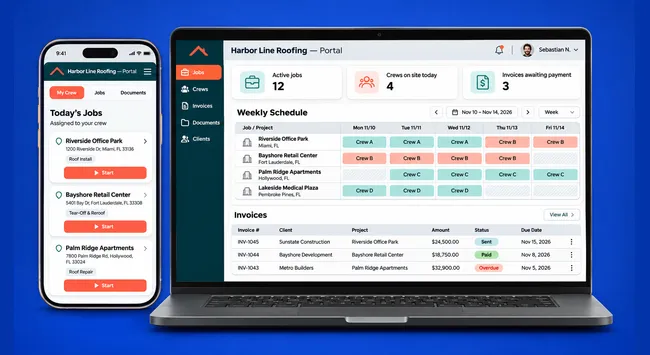
A roofer who wants a page per roof system, a company page with the license and a gallery usually fits Corporate Business, which lists a page for each service. A single page that says who you are and takes a call fits the Landing Page. Lead Generation is built around ads and city pages, and the Portal is for logins for your own crews and customers. The written quote fixes the scope.
The bilingual version appears in the Corporate Business listing as an add-on without its own figure, so it is quoted with the rest. For what drives the price, read how much a subcontractor website costs in South Florida, or see our business website design service.
Roofing is one of four trades in this series; the guides for the electrical version of this guide, what an air-conditioning contractor’s site needs and drywall and painting site, step by step follow the same license, insurance and photo rules, each with the pages its trade needs.
Frequently asked questions
Should a roofing company's site handle repair calls and new-roof bids differently?
Yes, when it takes both. A repair call comes from someone with a leak who wants a phone number, while a bid comes from an estimator with plans. Put click-to-call at the top and the plans form on its own page, each clearly labeled.
Can a roofing company start with a single page?
It can, if the page carries the license, the systems you install, the counties you cover and a few captioned photos. A small company that is easy to verify can still pass a GC's review. Add a page per roof system as the work calls for it.
Who should the site say is on the roofing crew?
Describe the crew the way your license and insurance do. The DBPR FAQ says roofers must be employees of the licensed contractor or leased through a licensed employee leasing company, so avoid wording that suggests otherwise, and ask the licensing office or an attorney if unsure.
To see how your roofing pages would be organized, book a free 30-minute call; SENAVIA walks through it with you, roof by roof.