What does each platform do, and what does it not do?
According to PlanHub's site, it is a commercial construction bidding marketplace where general contractors, subcontractors and suppliers meet. Autodesk's BuildingConnected page describes a platform that connects general contractors, subcontractors and owners around bids.
Each platform is built around the bid. On PlanHub's own page, general contractors find bidders, and subcontractors find projects and prepare their bids. On Autodesk's page, subcontractors have a tool to track bid invitations and deadlines. The Blue Book has its own site where you can read what it offers; the points below apply to any listing you keep, that one included.
What those pages do not describe is a place for your company to tell its own story. A profile is a card inside someone else's product, laid out the way the platform lays out every card. That is a fair trade for the invitations it can bring, and it leaves open what follows. Our subcontractor website page sums up the case in one section; this guide shows how the pieces fit.
What does an estimator look for when typing your company name into Google?
An estimator who has never worked with you can type your company name into Google before sending plans. What comes back is usually your website if you have one, your Google Business Profile and the platform profiles, in an order Google decides. Each result answers a different question.
That person has a trade package to cover and a due date. They want to know that you exist, that you work in their county, that you hold the license and carry the insurance the job calls for, and that you have built something like this before. Then they want to know how to reach you.
- The website can answer all of that in your own words: trades, counties, license details, finished jobs and a way to send plans.
- The Business Profile shows the phone number, hours, service area and reviews that people have left.
- The platform profile shows what the platform asks every member to fill in.
If only the third result exists, the estimator has one card and has to guess the rest. If all three exist and agree, the decision gets easier. Some estimators never search because the invitation came from someone they trust, but the search is cheap, so be ready for it.
Offices with many requests tend to sort quickly, and a clear result page helps a company stay on the list. More on that in how subcontractors get more bid invitations.
How do the profile and the website point at each other?
The profile can carry your website address, and the website can say where you receive invitations. Beyond those two links, keep the same company name, trade, phone number and list of counties in both places, so an estimator who finds either one sees the same company.
Here is a short routine that works for most trade companies:
- Pick one exact company name and use it everywhere, with the same spelling and the same punctuation.
- Add the website address to every platform profile that has a field for it, and to your Business Profile.
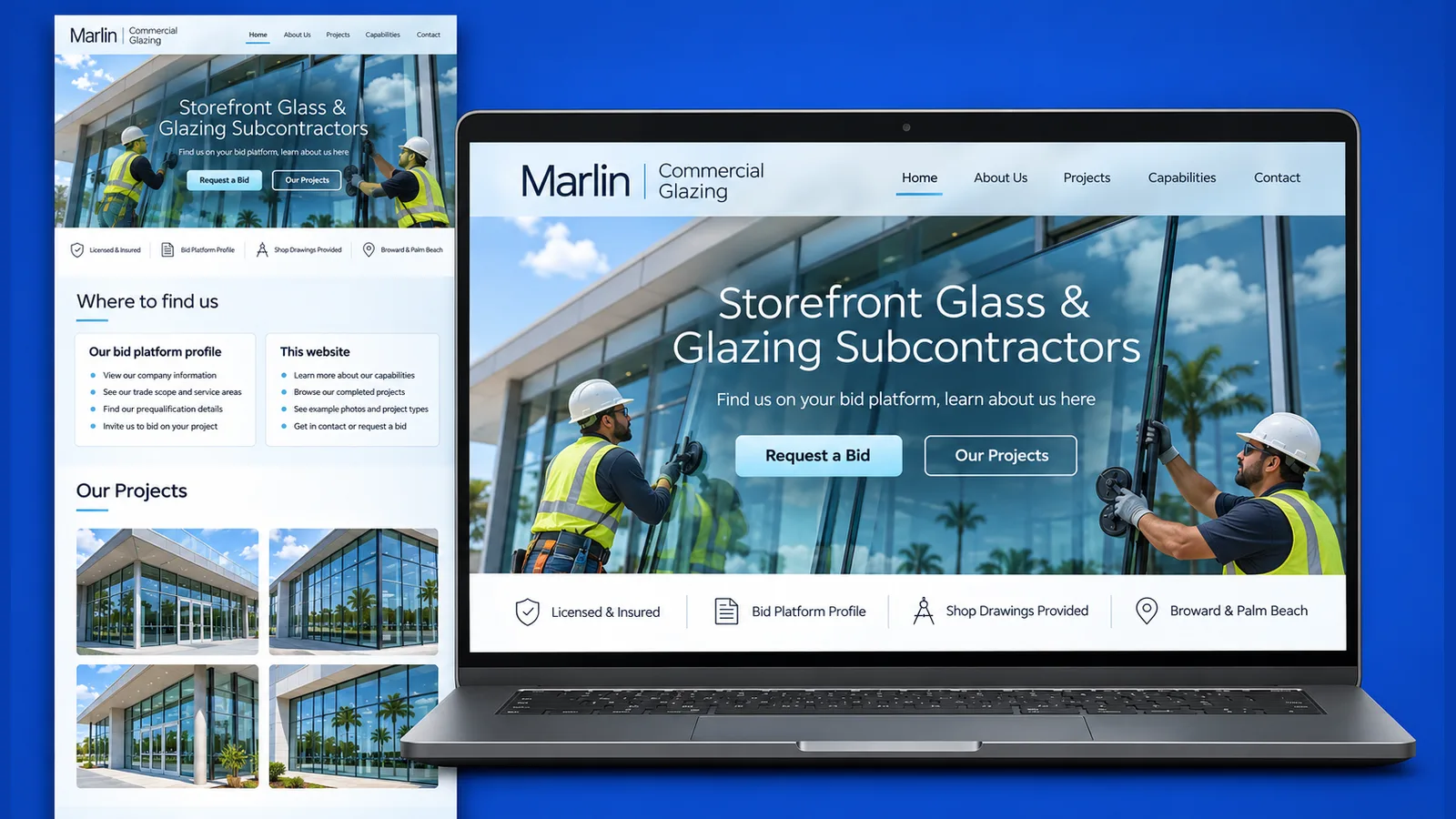
- Add a line to the website, in the footer or on the contact page, saying which platforms you receive invitations on. That way a project manager who got your name from a bid list can confirm it is the same company.
- Match the details: main phone, estimating email, trade, counties served. If you change one, change the others the same week.
- Point the bid form at your estimating inbox, so a request from the site lands in the same place as an invitation from a platform.
On the plans side, the form we describe in the bid request form that accepts plans is what turns a visit to your site into a request your estimator can price. The platform brings the invitation; the form catches visitors who found you another way.
Not sure your profiles and site match? Book a free 30-minute call to compare them together.
What can't a platform do for you?
A profile lives on the platform's domain and follows its layout. What a site you control adds is yours to shape: a domain of your own, a page for your license and insurance, a bid form that takes plans the way you choose, a Spanish version in your words, and photos organized by the kind of work you do.
One at a time:
- A domain that belongs to you. Your address and your email on that domain stay with the company whatever happens to a subscription or a platform's layout.
- A page for your license and insurance. Our guide to showing license and insurance on a Florida contractor site covers it, including the certificate of insurance (COI) offered on request. The COI is the one-page proof of coverage a general contractor (GC) usually asks for before a sub steps on a job.
- A bid form built around your work. It asks the questions your estimator needs and sends each request where your team will see it.
- Spanish. Many crews and some owners in South Florida read Spanish first. A bilingual site lets each one read in the language they prefer, while GC, bid and COI stay in English because that is what the industry says.
- Photos by type of work. A paver driveway, a pergola, a deck and a fence each get their own gallery with the city and the scope in the caption.
Place matters too. Our pages for Fort Lauderdale and Hialeah show how a site can speak to a county in a way a generic listing cannot.
When is the profile enough, and do subcontractors need a website anyway?
If you work for one or two general contractors who already know you and send you work directly, the profile can be enough for now and the website can wait. A site starts to pay its way when you want invitations from offices that have not met you.
So, do subcontractors need a website? It depends on where your next job comes from. These are the situations where waiting makes sense:
- Your work comes through a short list of general contractors who call you first.
- Your backlog is full and you are not taking on new offices.
- Your platform profile is complete, current and linked to a phone that someone answers.
And these are the ones where a website starts to help:
- You want to be invited by general contractors you have never worked with.
- Estimators ask you for your license, insurance and references by email every time.
- You work in more than one county and the platform does not show that clearly.
- Your crews or customers read Spanish.
No website can promise invitations. What it can do is remove common reasons for an estimator to move on: missing documents, no similar work to look at, an unclear service area. Our business website design plan covers that range for a company that wants a site of its own, in English and Spanish, without a long project.
Unsure which group you fall in? Book a free 30-minute call for a plain answer on whether the profile is enough for now.
When you do decide to build the site, bring a list to the first meeting: our guide on questions to ask a web design agency if you are a subcontractor covers domain ownership, who writes the text and what the price should include.
Frequently asked questions
Does having a website mean I should leave a platform?
No. The two do different things, and the platform can keep sending you invitations while the site handles what happens once someone is curious about your company. Keep the profile current and link it to the site.
Who updates the profile when I add a county or a trade?
You do, or someone in your office. Treat it as a short checklist whenever something changes: the profile, the Business Profile and the website. Doing all three in one sitting keeps the details matching.
What if my profile and my website show different phone numbers?
An estimator may call the wrong one or wonder which company is which. Choose the number you answer fastest, put it everywhere, and let the other lines forward to it until you can retire them.