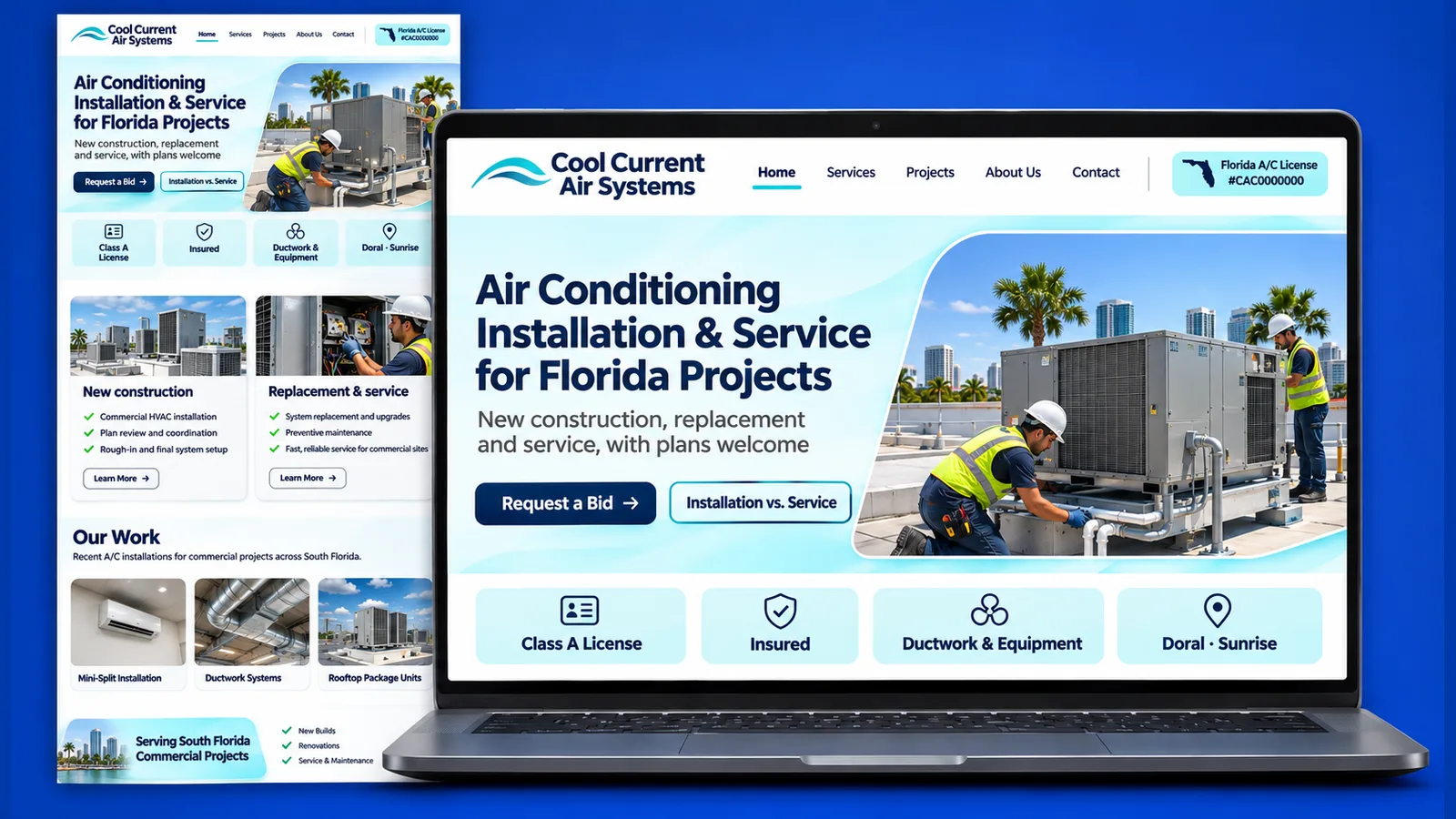
Before an estimator sends an invitation to bid, the website of an air conditioning company gets a quick pass: is the license real, is the work installation or service, and can plans reach someone who will answer. This guide builds an HVAC subcontractor website around that pass. SENAVIA, a web design agency in Plantation, prepared it as general guidance rather than legal advice.
What pages does an HVAC subcontractor website need?
A home page, a new-construction installation page, a replacement and service page, a gallery, a license and insurance page and a quote form that takes plans cover most of what a general contractor (GC) and a homeowner look for. Build them in this order and add more only when the work calls for it.
- Home: your trade, the counties you cover, the license number at the bottom and a clear way to ask for a quote.
- New-construction installation: the kinds of buildings you equip, that you bid from plans and that you answer addenda.
- Replacement and service: the page for owners, with a phone button and the hours you answer.
- Gallery: finished jobs sorted by building type, with the captions our guide to project photos that win bids recommends.
- License and insurance: the number and class, how to get your certificate of insurance (COI) and a link to verify the license.
- Quote form: it receives the drawings, a due date and a name to reply to, and routes everything to your estimator; a Spanish version sits beside it.
The form deserves the most care. A drawing set sent from a phone, with the due date attached, usually gets an answer sooner than one the estimator has to chase. If the form rejects a large file, the GC can move on to the next company on the list. Ask for a file size limit that fits a full drawing set.
Unsure which of these your current site is missing? Book a free 30-minute call and we will check it against this list.
Which license does an air conditioning contractor hold in Florida, and how does the site show it?
Air conditioning is one of the categories the DBPR lists as requiring registration or certification, according to its construction industry FAQ. The FAQ explains that a certified license reaches the whole state, while a registered one stays within a county or city plus neighboring places willing to accept it.
On its construction industry page, the state's Construction Industry Licensing Board divides the air-conditioning contractor into Class A, Class B and Class C. It describes Class A as unlimited in the covered work and Class C as limited to servicing air-conditioning, heating or refrigeration systems. Show the class you hold; a GC reads it to see which jobs your license can take. Copy the number, class and business name exactly as the state record prints them.
Print the number and class at the bottom of each page, repeat them on the license and insurance page and link the state's Verify a License service, which the DBPR describes as a way to verify a business or profession license. That lets the GC confirm you without a phone call. Where the number goes under the advertising rule is in our guide to the license number and insurance on a contractor website.
With a registration, name the cities or counties where it is valid rather than claiming all of Florida; a statewide promise on a local registration is the kind of mismatch a careful GC notices.
How do you separate new construction, replacement and service on the site?
Give each audience its own page. A GC wants installation from plans, a schedule and coordination with other trades; an owner with a unit that stopped cooling wants a phone number and a visit. Mixed on one page, both can leave without finding their answer.
- New construction: written for the estimator. Say which building types you equip, that you work from drawings and which trades you coordinate with. Link the quote form from the top of the page.
- Replacement: written for the owner or the property manager. Explain how a visit starts and what you need from them, such as the age and location of the unit.
- Service: a short page with the phone button first, the area you reach and the kinds of equipment you repair.
Keeping them apart can also help search. A person typing a repair question and a GC searching for a subcontractor are asking different things, and one page per intent lets each find its own answer.
The same split works on the Spanish side. Crews and homeowners who read Spanish get the same pages in the Spanish spoken in Florida, while the trade's own shorthand, bid, GC and COI, keeps its English form with a brief gloss at first use.
What does a general contractor check before inviting an HVAC subcontractor to bid?
A GC usually confirms the license, asks for the certificate of insurance (COI), looks for finished jobs similar to the one being bid, checks the counties you cover and wants a sense of your crew. Your site can answer these before anyone writes to you.
- License: number, class and the place where it is valid.
- COI: a note that you send it on request, with the contact who does.
- Similar jobs: photos grouped by type of building, with a caption that names the work.
- Counties: only the ones you really serve, each named.
- Crew: describe how a job is staffed, without a headcount.
Our guide to license and insurance on a contractor website covers the first two in depth. For a city example, SENAVIA's Doral page already answers what an air conditioning subcontractor there should publish, so this article does not repeat it. If your jobs sit mostly in Broward, the Sunrise page shows how a nearby area gets described. For every trade at once, see website design for subcontractors.
Want to know what an estimator finds on your site today? Book a free 30-minute call with SENAVIA.
What does an HVAC subcontractor website cost, and how long will it take?
The starting prices on SENAVIA's pricing page run from $650 in 1 month (Landing Page) to $1,750 in 2 months (Corporate Business) and $3,750 in 3 months (Lead Generation). A portal with logins starts at $9,475 and takes 3.5 months.
The pages listed earlier fit Corporate Business, which includes up to 10 pages; a bilingual site is an add-on, so mention it when you ask for a quote. If all you need today is one page that proves your license and shows your work, the Landing Page is the smaller start. Logins come later, if ever. What you finally pay depends on the scope, the counties and the languages.
For a line-by-line comparison read subcontractor website cost in South Florida; the build itself is part of SENAVIA's business website design service.
Air conditioning is the third of four trade guides. Read roofing subcontractor site, step by step, the electrical version of this guide and what a painter’s site needs if your company also bids those scopes, or compare how each one lays out its pages.
What do air conditioning companies ask before they order a site?
If we do both installation and repair, should the site say so?
Yes, on separate pages. The installation page speaks to the GC and the service page to the owner, and each links to the other so nobody has to guess what else you do.
Does the class on my license change what the site says?
It can. The board page describes each class differently, so state the one you hold and bid under, and do not describe work beyond it.
Can the site replace the bid invitation platforms?
It does a different job. A listing on a bid platform introduces you; your site is where a GC goes to check you, so it needs the license, the insurance note and the photos on its own pages.
If you would like a second opinion on how your pages read, book a free 30-minute call with SENAVIA, or see our page on subcontractor website design across every trade.