A general contractor (GC) who opens your website may also be reading an advertisement, and in Florida that matters for one specific line of text: your license number. This guide reads the statute, explains which license to show and where to place it, and says what to publish about insurance. It comes from SENAVIA, a web design agency in Plantation that builds sites for trade contractors in South Florida. It is a practical guide, not legal advice.
Is a contractor license number on a website required in Florida?
Florida Statute 489.119(5)(b) says the number of each contractor "shall appear in each offer of services, business proposal, bid, contract, or advertisement, regardless of medium." Subsection (5)(d) excludes business stationery and promotional novelties from "advertisement." Read the current text of F.S. 489.119.
A website that offers your services normally falls under "advertisement, regardless of medium," so the number usually belongs on it. The DBPR's construction industry FAQ points the same way: its list of what "advertise" covers includes "electronic media including Internet sites." Whether a particular page, profile or document is covered in your situation is a question for the statute itself and for an attorney, not for a web designer.
Subsections (5)(a) and (5)(c) of the same statute cover permit applications and vehicles, so the number is already on much of what a contractor prints. The website is one more place where it has to appear.
Which license do you show: your DBPR category or the county certificate?
Show the license you actually hold, and say which kind it is. The DBPR's construction industry FAQ explains that a certified license covers work across the whole state, while a registered license stays tied to the county or city of registration, plus adjoining places that accept it.
Some trades also carry a county credential. In Palm Beach County, the county's contractor certification page calls the Certificate of Competency its own contractor's license. If you hold both a state license and a county one, list both with their own labels, so a reader never wonders which number belongs to which.
The word "certified" on your site should mean only that category. Avoid using it as a loose adjective about your quality, because the DBPR gives it a specific meaning and a GC may read it that way.
If you are unsure which category applies, the license record itself shows it. Copy the number and the category exactly as the record prints them, then use our subcontractor website guide to place them with the rest of your credentials.
Where does a general contractor look for your license on your website?
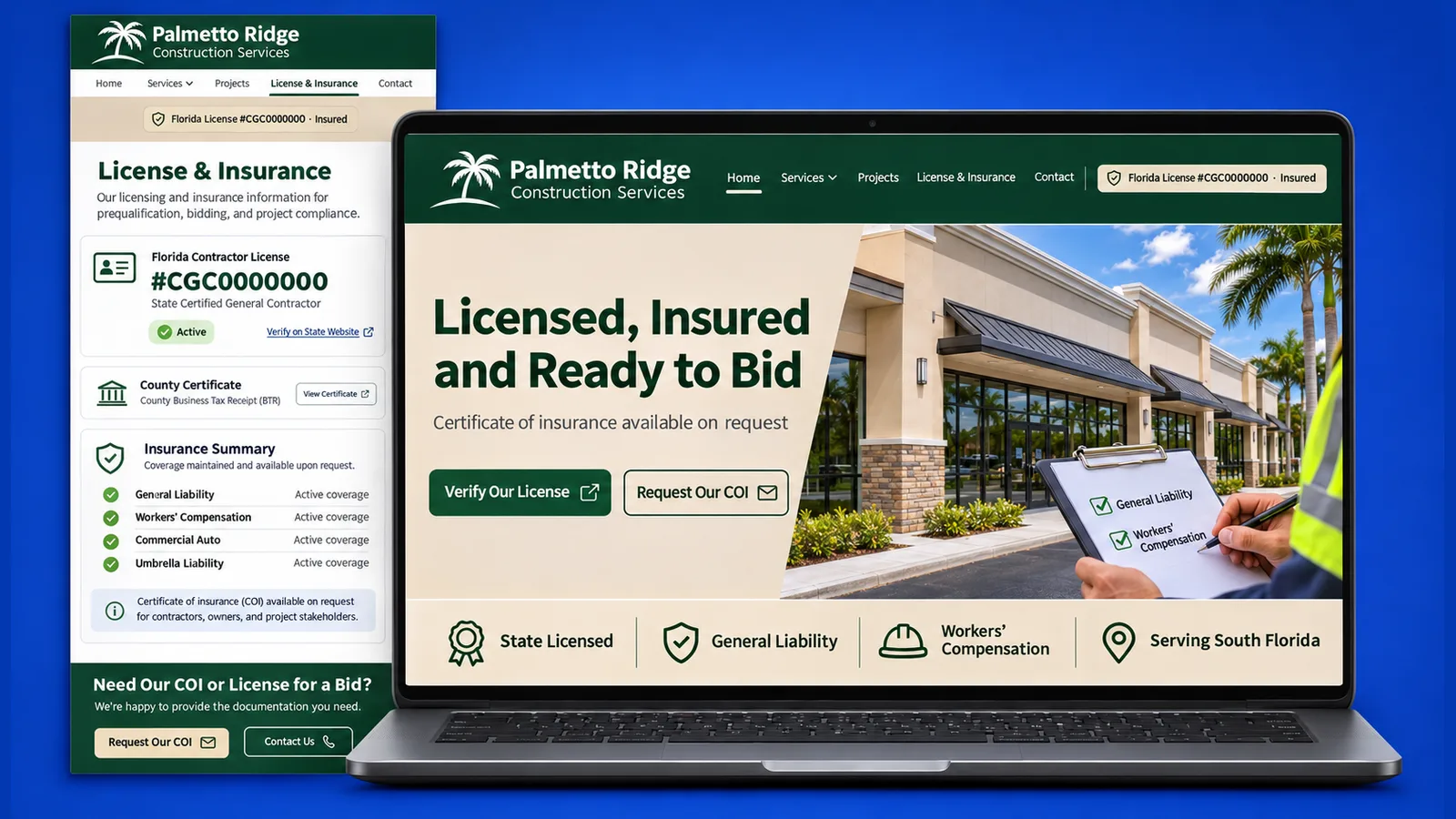
A GC usually checks three places: the footer, the About page and the area around the quote request form. Whatever it finds is then compared with the state's record, which the DBPR's online services page lists under Verify a License, so the number on the site should match that record exactly.
- Footer: the number, the category and the legal business name, on every page, so it travels with whichever page a visitor lands on.
- About page: a short paragraph with the same details, the counties you work in and a link to the state lookup.
- Next to the quote form: one line above the button, because that is often where an estimator decides whether to send plans.
Keep the business name identical to the one on the license. An estimator who sees a slightly different name may have to stop and ask, and a question can be a reason to pick the next company. Our sibling guide, what general contractors check before inviting a subcontractor to bid, shows the rest of that review; this one stays with what the page must display.
If you would like a second pair of eyes on your pages, book a free 30-minute call and we can walk through where each number goes.
What is a certificate of insurance (COI), and what do you publish about it?
A certificate of insurance (COI) is a document your insurer or agent issues to show which coverage is in force for your company. A GC usually asks for it after the license check. On your site, publish that you carry the coverage and that a current COI is available on request. Do not publish the document itself.
There are good reasons for that. A COI is a snapshot, and policies renew, so a posted copy can quietly go out of date. It also names parties and policy details that you may prefer to share only with the person who asks. The DBPR's FAQ describes insurance requirements for licensees, and the exact types and amounts that apply to you should be confirmed with the state and your agent.
A clear pattern is a short "Insurance" block: the coverage types you carry in plain words, a sentence saying a certificate is sent on request, and a request button that goes to the person who issues them. The GC can check the coverage at a glance and request the paper without a phone call.
What changes in Miami-Dade, Broward and Palm Beach?
The state rule is the same in all three counties, but the county credential differs. Miami-Dade's licensing page says its Construction Trades Qualifying Board has authority over certain county licenses and their scopes. Broward and Palm Beach handle theirs through their own offices.
- Miami-Dade: the county's Contractor Licensing Section and the Construction Trades Qualifying Board cover the licenses the county issues. A Hialeah subcontractor can see how a local page carries this in our Hialeah page, for Miami-Dade County.
- Broward: the Building Code Division handles the application for a Certificate of Competency, and its packet includes the Examining Board calendar. See our Coral Springs page, for Broward County.
- Palm Beach: the county page also says state-licensed contractors must enroll their state license with the county to apply for permits in unincorporated areas. See our Delray Beach page, for Palm Beach County.
The practical lesson for a website is simple: name the counties where you hold a credential, label each number, and keep the text current. A site built on a business website design plan can hold all of this in the footer and the About page without cluttering the home page.
Frequently asked questions
What if I work in several counties?
List each credential you hold with its county and label. The statute's text also notes that local governments may require locally licensed contractors to display their certificate of competency or license numbers, so check what each place expects. Where a rule is unclear, ask the licensing office or an attorney.
Do I have to show the qualifier's name?
The statute text we read speaks of the number, not of a name. Palm Beach County's page defines the qualifier as the owner of a county license and the person responsible for work under it. Whether to name that person on your site is a business decision; confirm anything required with the licensing office.
What about my social media profiles?
The phrase "regardless of medium" in the statute suggests that a business profile offering services may be treated like other advertising, so putting the number in the profile's description is a cautious choice. For your own case, read the statute and ask an attorney.
When your credentials are ready, book a free 30-minute call and we can set them up on your site, in English and in Spanish.