Inventory & Operations
Track stock, orders, and day-to-day operations in real time from one central module.
A custom ERP in Miami replaces disconnected spreadsheets and apps with one system for inventory, finance, operations and HR, built module by module around how your company already works. SENAVIA designs it, codes it and connects it to the accounting and payment tools you keep, and the code is yours.
Book a Free Call
When a business grows, its spreadsheets, apps, and side systems stop keeping up — numbers disagree, work falls through the cracks, and nobody has the full picture. SENAVIA builds custom ERP systems for companies across Miami-Dade, Broward, and Palm Beach that unify inventory, finance, operations, and HR into one modular platform.
As a bilingual EN/ES team, we engineer each module around how your business actually runs and connect them so data flows end to end. Built on a modern stack with clean, documented code you own — a single source of truth that scales with you, not another rigid off-the-shelf suite.
Schedule a Free Consultation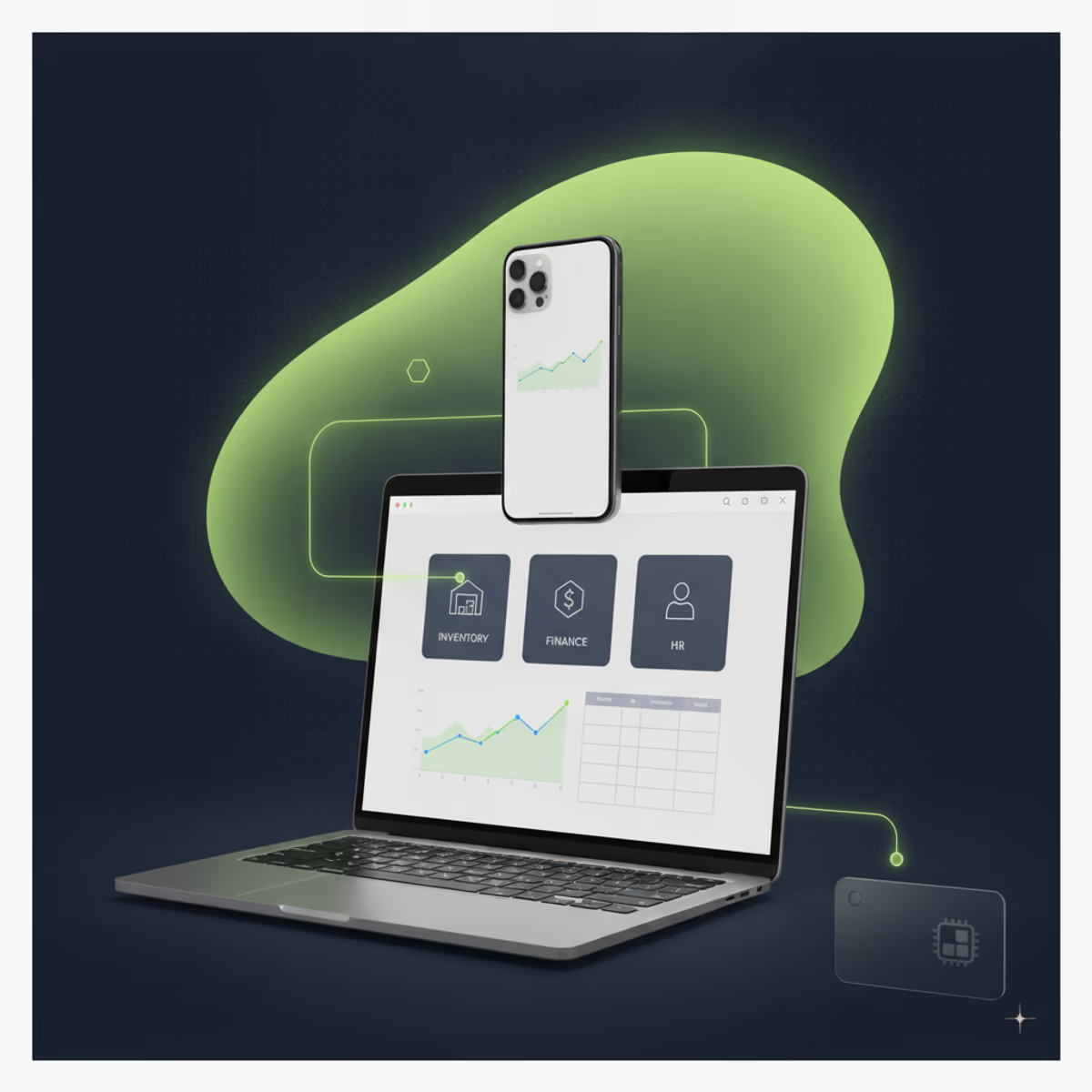
When the workarounds cost more than the software. Typical signs: inventory counts that disagree between systems, a month-end close that depends on one person’s spreadsheet, and a packaged suite whose per-user licenses keep climbing while its workflow still does not match yours. Distributors, contractors and multi-department firms tend to hit this first.
A packaged ERP is the right call when your process is standard and the vendor’s modules cover it. Custom makes sense when your edge is in the process itself — how you quote, allocate stock or schedule crews — and the software should follow it. If the real gap is visibility rather than process, a lighter admin dashboard over your current data may be enough.
Cost follows the number of modules, the integrations each one needs, the data you migrate, and the roles and approvals it must enforce. Because of that, we scope and quote an ERP by phase, in writing, rather than as one large number for a system nobody has mapped yet.
A common first phase is the module that hurts most — often inventory or orders — connected to the accounting you already use through an API connection. Finance, HR or reporting follow once the first module is in daily use, and a CRM can join the same foundation later. Our published pricing covers websites and portals; ERP work is always quoted on its own.
Data moves in rehearsals, not in one weekend. We map every field from spreadsheets or the old system, clean duplicates, run test imports your team checks, and only then set the cut-over date. Where it is needed, we plan a period in which both systems run side by side.
Training happens in English and Spanish, with role-based screens so warehouse, office and management each see their own part. Teams anywhere in Miami-Dade, including Doral and the city of Miami itself, can review each phase with us in person. It is part of our custom software development work.
Track stock, orders, and day-to-day operations in real time from one central module.
Invoicing, billing, and financial reporting connected to the rest of your operation.
Employees, roles, and scheduling managed alongside the work they support.
Start with the modules you need and add more over time — no rip-and-replace.
Cross-module dashboards and reports that finally give you the full picture in one place.
Modules follow how your company quotes, stocks and bills, instead of forcing it into a packaged suite.
Replace disconnected spreadsheets and apps with one system your whole company trusts.
Module screens and role-based training in English and Spanish, so the warehouse floor and the front office learn the same system.
Add modules as you grow, so the system expands with your operation instead of boxing it in.
Custom-coded and documented — no per-seat licensing on a suite you can’t change.
Maintenance, monitoring, and new modules as your business keeps evolving.
An ERP unifies the core of your business — inventory, finance, operations and HR — in one system. If your team juggles tools and spreadsheets that no longer agree with each other, it is worth a conversation; if one product already covers your process, it may not be.
Yes. It is common to keep QuickBooks for the books while the ERP runs operations, with invoices, payments and customers synced through the QuickBooks API instead of exported by hand.
Yes, and it is usually the safer path. The data model is designed for the full system from the start, so later modules plug into the same records instead of forcing a rebuild.
No. You own the code and the data, so adding users or locations changes your hosting needs, not a license fee, and no vendor can raise the price of the system your company runs on.
Some, by role. We train each group on its own screens in English or Spanish and leave a written guide, and because the ERP follows your existing process, the learning curve is mostly about the interface, not a new way of working.
Custom admin panel development for South Florida teams: live KPI dashboards, data tables, filters, user roles and reports in one panel built on your own data.
Learn more →Custom payment API integration in Florida: Stripe and gateway checkout, webhooks, and two-way sync with your CRM, ERP and accounting. Built in Plantation, FL.
Learn more →30 minutes, no commitment. Tell us where inventory, orders and finance stop agreeing and we will suggest which module should come first.
What customers see is only one layer: these are websites we have launched, the public face that an ERP ties to the stockroom and the books.

Premium website for a licensed Florida pool builder featuring 3D design visualization, luxury project gallery, and a lead capture funnel.
View case study
Custom Webflow website for a South Florida pergola contractor built to generate leads and compete in local outdoor living searches.
View case study
Professional website for a Miami pergola and screen enclosure contractor targeting homeowners across Miami-Dade, Broward & Palm Beach.
View case study
Website for a licensed Florida general and roofing contractor serving property portfolios, with commercial service pages, project results and a Spanish version.
View case study
South Florida IT consulting and staffing firm — consulting, direct-hire placement, system integration and application management.
View case study
Corporate website for a U.S. staffing agency showcasing temporary, temp-to-perm, and direct hire workforce solutions for businesses.
View case study
Operations panel for a Florida general contractor: jobs, pricing, tasks, purchases and roles in one web app, synced with Podio, with a portal for subcontractors.
View case studyWe understand your goals and challenges, create a tailored plan with clear estimates, and build a custom solution designed for your success.

We analyze goals, audience, and market to uncover growth opportunities across South Florida.

We define a clear project plan aligned with your budget, timeline, and objectives.

We build high-performance websites and platforms optimized for SEO and conversions.

We launch and optimize your digital presence from Plantation, serving South Florida.
Read what companies that have built with SENAVIA say in their Google reviews. An ERP is a longer engagement, which makes the steady communication they mention matter even more.
 Jesus Avila Apr 2026
Excellent collaboration with Senavia Corp! They performed a fantastic job realizing my idea for my website. Everything is tidy, polished, and precisely how I wanted it. I would especially like to thank Sebastian for his assistance during this process. He was understanding, patient, and responsive. Strongly suggested!Review on Google
 Ana Garcia Jan 2026
Sebastian y su equipo son expertos en páginas web. Su conocimiento y profesionalismo los hacen los mejores! Tienen nuestra recomendaciòn.Review on Google
 Noel Rodriguez (Inspector Bros) Nov 2025
We just partnered up with Sebastian to create our website and couldn’t be any happier with all his help, professionalism, attention to detail and creativity. He made the whole process extremely easy. Helped us each step of the way to locate and create the entire website. We will certainly continue to work with Sebastian and his team in the future. Highly recommended!!Review on Google
 Lucas Berdugo Nov 2025
Sebastian is very professional, very patient and knowledgeable. I recommend his services hands down. You won’t regret it.Review on Google
 Ninoska Diaz Caballero Aug 2024
Working with Senavia has been a good experience, knowing that you are in the hands of experts who will design your website exactly as you thought, they help you with very positive ideas with a very satisfactory final result. I recommend them 100%. Thank you. Senavia!Review on Google
 INTERCREDIT SOLUTION May 2024
Excelente servicio muy profesionales, los recomiendo 100%Review on Google
 Alejandro Gutierrez May 2024
I had the pleasure of working with Senavia and especially with Sebastián, the owner of the company. They provided exceptional Community Management services for my business. Sebastián and his team were professional, efficient, and always attentive to our needs. Their expertise and dedication significantly improved our community engagement and overall management. I highly recommend Senavia to anyone looking for top-notch Community Management services. Thank you, Sebastián, for a job well done!Review on Google
 Janyer Pino May 2024
Excelente profesional, recomiendo ampliamente los servicios que suministra Sebastián y su equipo de trabajo. Si quieres ampliar tu cartera de clientes es la persona que debes contactar.Review on Google
 Jaknery Valero Apr 2024
Excelente trabajo! Fue mucho mucho de lo que estaba buscando! GraciasReview on Google
 ANGELICA CASTILLO Mar 2024
Me encanto la página que me hicieron, muy profesionales en su trabajo.. y lo que me gustó que siempre al servicio del cliente totalmente 100% recomendados.Review on Google
 Mayela Reyes Oct 2023
Wanted to share how satisfied I am with Senavia Corporation!! Highly recommend to take your business to another level! Excellent service Sebastian!Review on Google
 Caleb Rojas Oct 2023
Amazing service! Highly recommend! Sebastian is always on top of things!Review on Google
 Gabriela Calles Da Silva Oct 2023
Excelente compañía sus website son espectaculares, trabajo impecable y profesionalReview on Google
 Fernando Morales Oct 2023
Excelente servicio entregado por Sebastián y su compañía. Comunicación fluida y permanente preocupación. Profesionales en todo aspecto. Recomendable al 100%Review on Google
 Mercedes Zulueta Aug 2023
If someone is looking for digital marketing? The Senavia company has the solution. Great job and thanks Sebastian 💯Review on Google
 Iris Seguí Aug 2023
Excellent!Review on Google
 Evelyn Ferriol Aug 2023
Very knowledgeable about marketing strategies and effective lead generation for your business!Review on Google
 Jorge daniel Heredia May 2023
Excellent and fast services. Sebastian was my heroe. Everything perfect. Thanks to all your team. Great jobReview on Google
 Mary Delgado Feb 2023
Highly recommended!!! The best in web design, super professional and friendly. Sebastian's guide was very reliable and satisfactory.Review on Google
 Juan Manuel Palacios Valencia May 2022
Fantastic service. My expectations were exceeded! Highly recommendedReview on Google
 Marlon Zubizarreta May 2022
Great service , I totally recommend this company and SebastianReview on Google
 Diego Colonia Apr 2022
Snavia corp went far beyond my expectations. I’m very happy. High quality work at a very competitive price and excellent service.Review on Google
 Luis Miguel Rodriguez Herrera Nov 2021
Un excelente trabajo y muy profesionales, también mostraron paciencia. En general es una excelente empresa de páginas. Se le recomendó.Review on Google
 David Arce Feb 2021
Senavia Corp. has definitely exceeded my expectations. They have done a professional job with all my web design needs. They go the extra mile to satisfy all ideas and targets for our business development. I highly recommend Senavia Corp.Review on Google
 Zen en Movimiento Feb 2021
Estoy muy satisfecho con el desarrollo de mi sitio web por parte del equipo de Senavia Cop. Desde el primer momento me di cuenta de su profesionalismo al ofrecerme una explicación de cómo era la gestión y producción del desarrollo de mi sitio web. Realmente estoy muy contento con el trabajo que me han entregado, ya que en cuanto al Diseño, rendimiento y contenido del website es muy profesional.Review on Google
Start with the module that hurts most today, put it into daily use, and add the rest of the ERP on the same foundation.
(954) 706-4084

