Process & Exception Mapping
The real flow, the edge cases and the owner of each step — written down before anything is built.
Workflow automation services connect the systems your team keeps re-typing between — CRM, accounting, ERP, email, your website — so quotes, invoices and onboarding steps move on their own, with every write validated, every run logged and a person approving anything with consequences.
Book a Workflow Review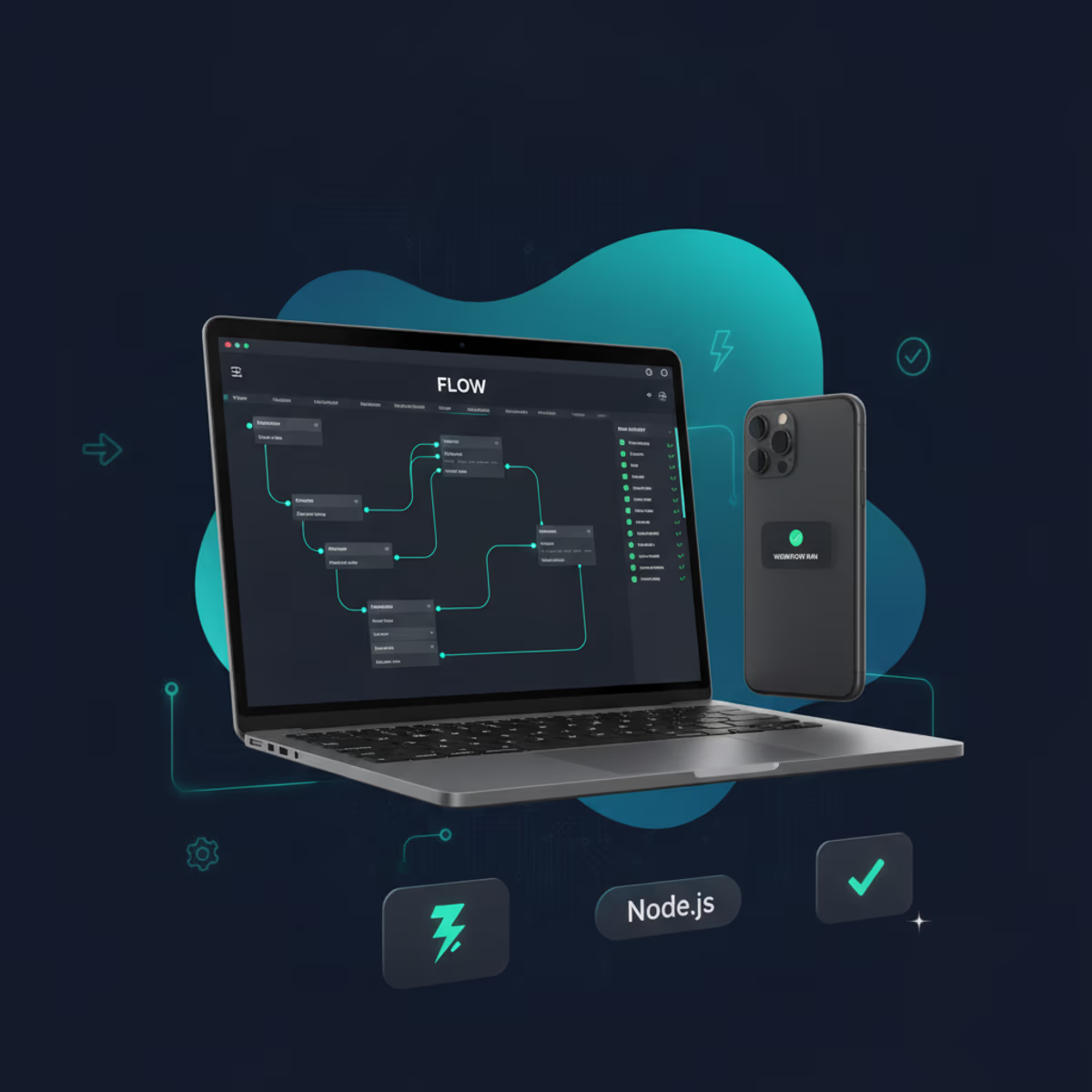
Connecting two business systems so work moves between them without re-typing takes 6 to 12 weeks, most of it spent on legacy systems rather than on the automation itself. We map the process, design the flow, build the integration on n8n, validate every write, and add the logs and alerts that let you trust it. AI is used only where it earns its place.
Most automation projects fail for an unglamorous reason: nobody wrote down what the exception cases are. A quote that arrives without a line item, an invoice that does not reconcile, a customer who exists twice. We map those first, because the exceptions decide whether the flow survives contact with your real data.
Every write is idempotent and every step is logged. Running the same job twice does not create two invoices, and when a dependency fails the flow stops and raises a task rather than improvising.
Schedule a Free Consultation
Start with a workflow that runs every week, follows rules a person could write down, crosses at least two systems and has a number you can measure today, such as hours spent or errors per month. If one of those four is missing, the payback is hard to prove.
Typical first candidates: a website form that should create a contact, a job and a confirmation email; an approved quote that should become an invoice; overdue invoices that need reminders; a new client who has to be set up in three tools. Each one is small enough to finish and visible enough to measure.
If several processes compete for the first slot, or nobody can say which one costs the most, the AI automation consulting audit ranks them with a baseline before anything is built.
The price tracks the integrations, not the number of steps. A flow between two modern apps with clean APIs is a small job; the same flow against an older ERP, a spreadsheet export or a system with no documentation takes longer to build and to make safe.
The other cost drivers are the number of exception paths, the validation each write needs, and where the orchestration runs, including whether it is self-hosted inside your environment. Monitoring and changes after launch are a separate monthly line, so the build price is not padded to cover them.
When a connection needs real engineering — a payment gateway, a legacy database, a custom endpoint — it is scoped as API integration work; when the process has outgrown the tools altogether, a custom ERP can be the cheaper long-term answer.
RPA bots click through screens like a person and break when a screen changes. API integrations move data between systems and survive those changes. AI agents read unstructured input such as emails or PDFs. We build on APIs and use AI only for reading.
Wherever an API or an export exists, we avoid screen-clicking bots. In a typical intake flow, an agent reads an incoming email and extracts the customer, the request and the deadline; fixed rules then decide where it goes and write the record. The agent never writes on its own judgement, which is what keeps the flow auditable.
If the reading happens in a live conversation with a customer rather than in an inbox, that is a customer-facing AI chatbot; both usually sit under the same AI automation project.
The real flow, the edge cases and the owner of each step — written down before anything is built.
Triggers, conditions and multi-step logic designed around how your operation actually runs.
CRM, ERP, accounting, email and your website connected through APIs and webhooks.
Rules, formats and totals checked before each write, so a repeat run never duplicates a record.
Run history, failure alerts and a documented rollback path your team can operate.
The exceptions get written down first — the quote with no line item, the client entered twice — because they decide the design.
Real connections to the systems of record, not a dashboard that duplicates them.
Reversible steps run automatically; anything with consequence waits for an approval.
Cycle time and error rate measured before and after, with the method written down.
You see every run, every failure and every cost — no black box between your systems.
Project management, documentation and the runbook delivered in both languages.
These cases are better solved another way first, and we will say so.
Usually not. We connect the tools you already pay for through their APIs or controlled exports, and we tell you before quoting if one of them cannot be reached reliably. Replacing a system only makes sense when the process itself has outgrown it.
Yes. The orchestration is built on n8n, which can be self-hosted on your infrastructure when the data must not leave it, and every credential belongs to a service account you control.
It depends on the architecture and the contracts, and we review both before building. Financial writes are validated against totals and formats, run under least-privilege accounts, and anything irreversible — a payment, a credit, a write-off — waits for a person to approve it.
The flow stops rather than improvising. It raises an alert, records the failure with its input and output, and creates a task for the owner. Reruns are idempotent, so recovering never duplicates records.
Against the baseline taken before launch: cycle time, error rate and hours spent on the task. The method is written down at the start, so the comparison after go-live is the one we agreed on, not one chosen afterwards.
AI consulting in Miami that starts with a readiness audit: we pick the process worth automating, check your data and hand you a costed blueprint to keep.
Learn more →AI chatbot development in Miami. We build support and sales agents that answer from your approved content, book appointments, and hand off to a person.
Learn more →30 minutes, no commitment. Walk us through one process your team repeats every week and we will tell you whether it can run on its own.
Portals, stores and business websites we have delivered in South Florida — the systems our workflow automations connect.

Premium website for a licensed Florida pool builder featuring 3D design visualization, luxury project gallery, and a lead capture funnel.
View case study
Custom Webflow website for a South Florida pergola contractor built to generate leads and compete in local outdoor living searches.
View case study
Professional website for a Miami pergola and screen enclosure contractor targeting homeowners across Miami-Dade, Broward & Palm Beach.
View case study
Website for a licensed Florida general and roofing contractor serving property portfolios, with commercial service pages, project results and a Spanish version.
View case study
South Florida IT consulting and staffing firm — consulting, direct-hire placement, system integration and application management.
View case study
Corporate website for a U.S. staffing agency showcasing temporary, temp-to-perm, and direct hire workforce solutions for businesses.
View case study
Operations panel for a Florida general contractor: jobs, pricing, tasks, purchases and roles in one web app, synced with Podio, with a portal for subcontractors.
View case studyWe understand your goals and challenges, create a tailored plan with clear estimates, and build a custom solution designed for your success.

We analyze goals, audience, and market to uncover growth opportunities across South Florida.

We define a clear project plan aligned with your budget, timeline, and objectives.

We build high-performance websites and platforms optimized for SEO and conversions.

We launch and optimize your digital presence from Plantation, serving South Florida.
The reviews below come from SENAVIA clients across our services, on Google; they speak to how we scope, communicate and deliver, which is what an automation project depends on.
 Jesus Avila Apr 2026
Excellent collaboration with Senavia Corp! They performed a fantastic job realizing my idea for my website. Everything is tidy, polished, and precisely how I wanted it. I would especially like to thank Sebastian for his assistance during this process. He was understanding, patient, and responsive. Strongly suggested!Review on Google
 Ana Garcia Jan 2026
Sebastian y su equipo son expertos en páginas web. Su conocimiento y profesionalismo los hacen los mejores! Tienen nuestra recomendaciòn.Review on Google
 Noel Rodriguez (Inspector Bros) Nov 2025
We just partnered up with Sebastian to create our website and couldn’t be any happier with all his help, professionalism, attention to detail and creativity. He made the whole process extremely easy. Helped us each step of the way to locate and create the entire website. We will certainly continue to work with Sebastian and his team in the future. Highly recommended!!Review on Google
 Lucas Berdugo Nov 2025
Sebastian is very professional, very patient and knowledgeable. I recommend his services hands down. You won’t regret it.Review on Google
 Ninoska Diaz Caballero Aug 2024
Working with Senavia has been a good experience, knowing that you are in the hands of experts who will design your website exactly as you thought, they help you with very positive ideas with a very satisfactory final result. I recommend them 100%. Thank you. Senavia!Review on Google
 INTERCREDIT SOLUTION May 2024
Excelente servicio muy profesionales, los recomiendo 100%Review on Google
 Alejandro Gutierrez May 2024
I had the pleasure of working with Senavia and especially with Sebastián, the owner of the company. They provided exceptional Community Management services for my business. Sebastián and his team were professional, efficient, and always attentive to our needs. Their expertise and dedication significantly improved our community engagement and overall management. I highly recommend Senavia to anyone looking for top-notch Community Management services. Thank you, Sebastián, for a job well done!Review on Google
 Janyer Pino May 2024
Excelente profesional, recomiendo ampliamente los servicios que suministra Sebastián y su equipo de trabajo. Si quieres ampliar tu cartera de clientes es la persona que debes contactar.Review on Google
 Jaknery Valero Apr 2024
Excelente trabajo! Fue mucho mucho de lo que estaba buscando! GraciasReview on Google
 ANGELICA CASTILLO Mar 2024
Me encanto la página que me hicieron, muy profesionales en su trabajo.. y lo que me gustó que siempre al servicio del cliente totalmente 100% recomendados.Review on Google
 Mayela Reyes Oct 2023
Wanted to share how satisfied I am with Senavia Corporation!! Highly recommend to take your business to another level! Excellent service Sebastian!Review on Google
 Caleb Rojas Oct 2023
Amazing service! Highly recommend! Sebastian is always on top of things!Review on Google
 Gabriela Calles Da Silva Oct 2023
Excelente compañía sus website son espectaculares, trabajo impecable y profesionalReview on Google
 Fernando Morales Oct 2023
Excelente servicio entregado por Sebastián y su compañía. Comunicación fluida y permanente preocupación. Profesionales en todo aspecto. Recomendable al 100%Review on Google
 Mercedes Zulueta Aug 2023
If someone is looking for digital marketing? The Senavia company has the solution. Great job and thanks Sebastian 💯Review on Google
 Iris Seguí Aug 2023
Excellent!Review on Google
 Evelyn Ferriol Aug 2023
Very knowledgeable about marketing strategies and effective lead generation for your business!Review on Google
 Jorge daniel Heredia May 2023
Excellent and fast services. Sebastian was my heroe. Everything perfect. Thanks to all your team. Great jobReview on Google
 Mary Delgado Feb 2023
Highly recommended!!! The best in web design, super professional and friendly. Sebastian's guide was very reliable and satisfactory.Review on Google
 Juan Manuel Palacios Valencia May 2022
Fantastic service. My expectations were exceeded! Highly recommendedReview on Google
 Marlon Zubizarreta May 2022
Great service , I totally recommend this company and SebastianReview on Google
 Diego Colonia Apr 2022
Snavia corp went far beyond my expectations. I’m very happy. High quality work at a very competitive price and excellent service.Review on Google
 Luis Miguel Rodriguez Herrera Nov 2021
Un excelente trabajo y muy profesionales, también mostraron paciencia. En general es una excelente empresa de páginas. Se le recomendó.Review on Google
 David Arce Feb 2021
Senavia Corp. has definitely exceeded my expectations. They have done a professional job with all my web design needs. They go the extra mile to satisfy all ideas and targets for our business development. I highly recommend Senavia Corp.Review on Google
 Zen en Movimiento Feb 2021
Estoy muy satisfecho con el desarrollo de mi sitio web por parte del equipo de Senavia Cop. Desde el primer momento me di cuenta de su profesionalismo al ofrecerme una explicación de cómo era la gestión y producción del desarrollo de mi sitio web. Realmente estoy muy contento con el trabajo que me han entregado, ya que en cuanto al Diseño, rendimiento y contenido del website es muy profesional.Review on Google
Pick one flow, connect the systems on both ends, and compare cycle time and errors against the baseline before adding the next.
(954) 706-4084

