Table of Contents Tabla de Contenido
- What You'll Learn in This Article
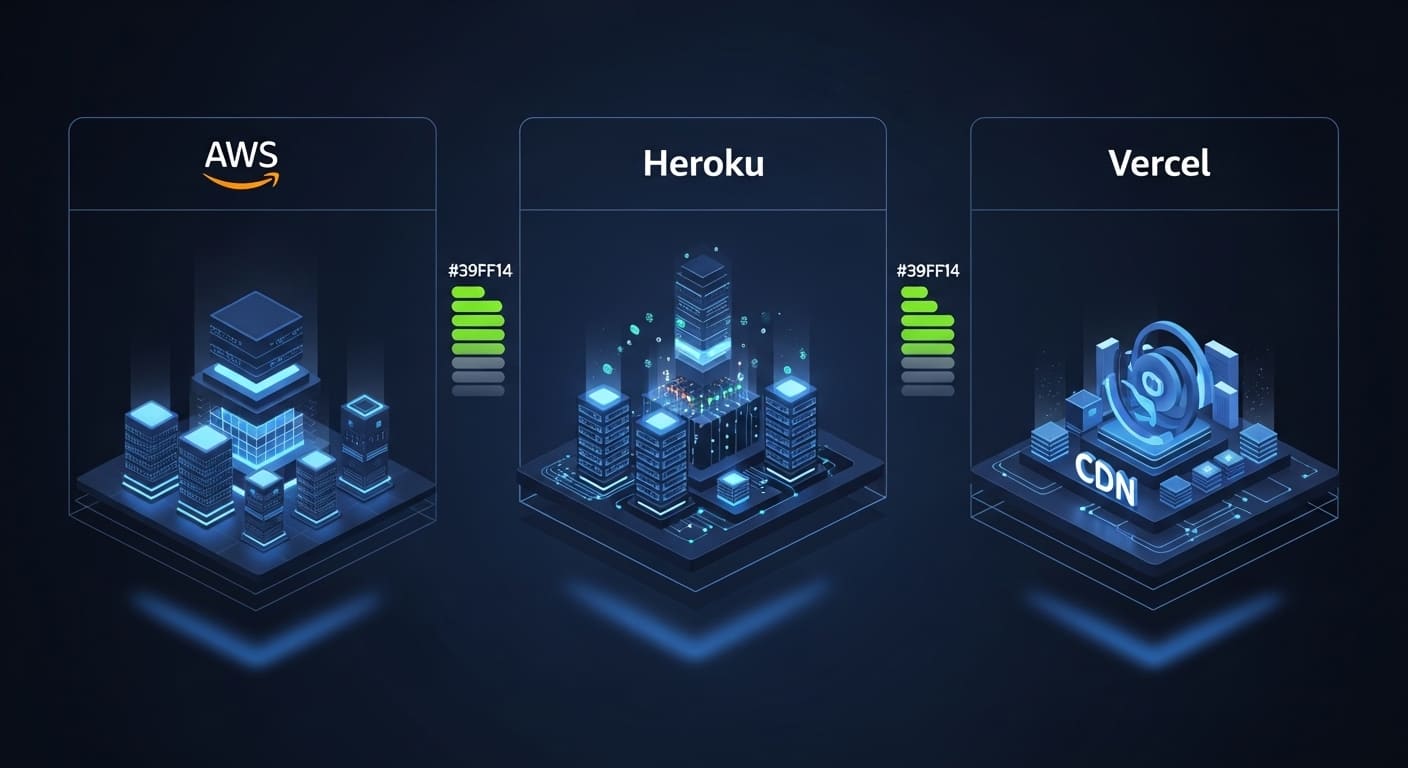
- Understanding the Three Platforms
- Real Cost Comparison: Three Workload Scenarios
- Performance Analysis
- Which Platform Should You Choose?
- Modern Alternatives Worth Evaluating in 2026
- Developer Experience Comparison
- Migration Considerations
- Frequently Asked Questions
- Conclusion: Match the Platform to the Application
Choosing the wrong deployment platform can cost your business thousands of dollars per year in unnecessary infrastructure spend — or force you to migrate your entire application at the worst possible time. AWS, Heroku, and Vercel each serve fundamentally different use cases, and the right choice depends on your application type, team expertise, traffic patterns, and budget. This technical analysis gives you the real-world data you need to make the right decision.
In 2025, Heroku suffered a major outage on June 10th and continued its post-free-tier pricing model that sparked mass developer migration. Vercel's serverless model has matured significantly. AWS has expanded its managed services to make cloud deployment more accessible for smaller teams. The 2026 landscape looks meaningfully different from just two years ago.
What You'll Learn in This Article
- How each platform works architecturally
- Real cost comparison with example workloads
- Performance benchmarks and trade-offs
- Which platform is right for your application type
- Developer experience and team learning curve
- Scaling behavior and limits
- Modern alternatives worth considering in 2026
- Frequently Asked Questions
Understanding the Three Platforms
AWS (Amazon Web Services)
AWS is the world's largest cloud platform, offering over 200 services covering compute, storage, networking, databases, AI, and more. For web application deployment, the primary AWS services are EC2 (virtual machines with full control), Elastic Beanstalk (a PaaS layer handling deployment and scaling), ECS/EKS (container orchestration for Docker-based apps), Lambda (serverless function execution), and App Runner (fully managed containerized app deployment with automatic scaling). AWS charges based on actual resource consumption with no platform markup — which is why it is typically the cheapest option at scale, despite the higher operational complexity.
Heroku
Heroku is a Platform-as-a-Service (PaaS) that abstracts away infrastructure management. Developers push code via Git, and Heroku handles deployment, scaling, and server management. Heroku's core concept is the dyno — a lightweight, managed container that runs your application processes. Following Salesforce's acquisition, Heroku eliminated its free tier in November 2022 and has shifted focus toward enterprise customers. Pricing starts at $5/month for Eco dynos (which sleep after 30 minutes of inactivity) and rises to $250/month for Performance-M dynos. In June 2025, a major outage affected thousands of hosted applications, raising reliability concerns among long-term users.
Vercel
Vercel is a frontend-focused deployment platform optimized for JavaScript frameworks, particularly Next.js (which Vercel created and maintains). Vercel deploys applications as serverless functions and static assets distributed across its global CDN and edge network. Every Git commit automatically generates a preview URL, and deployments take seconds rather than minutes. Vercel's pricing is based on Active CPU time — you pay only when your CPU is actively processing a request, not for idle time. The Pro plan starts at $20/month per team member. Since Vercel runs on AWS infrastructure, you pay a margin over raw AWS costs in exchange for the managed experience.
Real Cost Comparison: Three Workload Scenarios
Scenario 1: Small Business Web Application (10,000 monthly active users)
| Platform | Configuration | Estimated Monthly Cost |
|---|---|---|
| AWS (App Runner) | 1 vCPU, 2GB RAM, auto-scaling | $40–80/month |
| Heroku | Standard-1X dyno ($25) + Postgres ($9) | $34–60/month |
| Vercel | Pro plan ($20) + serverless function usage | $20–45/month |
Scenario 2: Growing SaaS Application (100,000 monthly active users)
| Platform | Configuration | Estimated Monthly Cost |
|---|---|---|
| AWS (ECS + RDS) | 2x t3.medium instances + RDS db.t3.medium | $150–250/month |
| Heroku | Standard-2X dynos (x2) + Standard Postgres | $250–400/month |
| Vercel | Pro plan + significant function execution | $100–300/month + database costs |
Scenario 3: High-Traffic Application (1M+ monthly active users)
| Platform | Notes | Estimated Monthly Cost |
|---|---|---|
| AWS | Full control, custom architecture | $800–5,000+/month (workload dependent) |
| Heroku | Performance dynos, limited flexibility | $2,000–10,000+/month |
| Vercel | Enterprise plan, custom pricing | Custom — contact sales |
The pattern is clear: Heroku tends to be the most expensive at scale, AWS becomes proportionally cheaper as workload grows, and Vercel is competitive at small-to-medium scale for frontend-heavy applications.
Performance Analysis
Cold Start Behavior
Cold starts — the delay when a serverless function is invoked after a period of inactivity — vary significantly across platforms. Vercel's Edge Functions have near-zero cold starts (typically under 100ms) because they run on V8 isolates rather than full Node.js processes. Traditional Vercel serverless functions have cold starts of 200–800ms. AWS Lambda cold starts range from 100ms to several seconds depending on runtime and memory configuration. Heroku dynos on the Eco plan sleep after 30 minutes of inactivity, resulting in 10–30 second startup times for the first request after sleep — a significant user experience problem for applications with irregular traffic.
Global Distribution
Vercel's CDN and edge network spans 70+ global regions, making it the strongest option for serving users worldwide with minimal latency. AWS CloudFront provides similar global reach but requires additional configuration. Heroku's infrastructure is US and EU focused, with limited edge distribution options without third-party CDN integration.
Which Platform Should You Choose?
The right deployment platform depends on your application type, team, and requirements. Here is a decision framework:
Choose Vercel if:
- You are building a Next.js, Nuxt, SvelteKit, or similar JavaScript-first application
- Your workload is primarily frontend rendering with relatively simple backend needs
- Developer experience and deployment speed are high priorities
- You have a small team that needs minimal infrastructure management
- You serve users globally and need edge-distributed content delivery
Choose Heroku if:
- You need rapid prototyping with minimal infrastructure setup
- Your team has no cloud infrastructure experience and needs maximum simplicity
- Your application is small-to-medium with predictable, modest traffic
- You require specific Heroku add-ons that have native Heroku integration
Caveat: Given Heroku's pricing trajectory and 2025 reliability issues, evaluate alternatives like Railway, Render, or Fly.io before committing to Heroku for new projects.
Choose AWS if:
- You need fine-grained control over your infrastructure
- You are building a complex application with multiple services or high scalability requirements
- Long-term cost efficiency is a priority (AWS is typically cheapest at scale)
- You have compliance or data residency requirements that require specific infrastructure configurations
- Your team has existing AWS expertise or is willing to invest in learning it
Modern Alternatives Worth Evaluating in 2026
The deployment landscape in 2026 offers strong alternatives that have emerged partly in response to Heroku's price increases:
- Railway: Modern Heroku-like experience with more competitive pricing, built-in databases, and better scaling. Strong choice for teams that want Heroku's simplicity without Heroku's cost.
- Render: Offers free tier with auto-sleep, managed databases, and a simple interface. A popular Heroku replacement for projects at small-to-medium scale.
- Fly.io: Deploys Docker containers to servers physically close to your users, combining the portability of containers with global distribution. Excellent for latency-sensitive applications.
- Cloudflare Workers: Edge-first serverless computing that runs JavaScript and WASM at Cloudflare's 300+ global locations. Near-zero cold starts, extremely low latency, and aggressive pricing. Limited runtime environment compared to full Node.js.
Developer Experience Comparison
| Factor | AWS | Heroku | Vercel |
|---|---|---|---|
| Time to first deployment | Hours to days | Minutes | Minutes |
| Learning curve | Steep | Gentle | Gentle |
| CI/CD integration | Flexible, requires setup | Built-in Git integration | Automatic Git integration |
| Preview environments | Manual setup required | Review apps (paid feature) | Automatic per branch |
| Database management | RDS, Aurora (excellent managed options) | Heroku Postgres (good but expensive) | Integration with third-party providers |
| Monitoring / logging | CloudWatch (powerful, complex) | Heroku metrics (basic) | Runtime logs, basic analytics |
Migration Considerations
If you are considering migrating from one platform to another, the key factors are: data migration (the most complex and risk-prone aspect), downtime windows (define acceptable downtime and design your migration to stay within it), dependency audit (list every platform-specific feature you use), and team training (migrating to AWS from Heroku is a significant skill investment — budget time for learning and consider infrastructure-as-code tools like Terraform).
Frequently Asked Questions
Is Vercel only for Next.js apps?
Vercel supports many frameworks including Nuxt.js, SvelteKit, Astro, Remix, and static sites. However, it is most optimized for Next.js because Vercel created and maintains the framework. Backend-heavy applications that require persistent connections, WebSockets, or long-running processes face limitations on Vercel's serverless model and may be better served by AWS or Railway.
Why is Heroku so expensive compared to alternatives?
Heroku's pricing reflects its platform abstraction overhead — you pay for the convenience of not managing infrastructure. As your application scales, this overhead compounds: a $50/month workload on AWS might cost $150–200/month on Heroku for equivalent performance. Following the loss of its free tier, Heroku has focused on enterprise customers and accepts higher churn from price-sensitive developers.
Can I use Vercel for a full-stack application with a database?
Yes, Vercel supports full-stack applications with Vercel Postgres, Vercel KV (Redis), and Vercel Blob (storage) as managed database options. You can also connect any external database provider. However, for applications with complex database requirements, high write loads, or long-running queries, a separate managed database service (PlanetScale, Supabase, AWS RDS) will perform better than Vercel's integrated options.
Which deployment platform is best for a South Florida startup?
For most South Florida startups building their first version of a product, Vercel (if Next.js/React) or Railway (for backend-heavy applications) offers the best combination of speed, simplicity, and cost at early stage. As you grow beyond 50,000 monthly active users and have established traffic patterns, migrating critical services to AWS for cost efficiency becomes increasingly worthwhile. At SENAVIA Corp, we help South Florida businesses choose and implement the right deployment architecture for their specific stage and requirements.
What are the best Heroku alternatives in 2026?
The best Heroku alternatives in 2026 are Railway (best overall Heroku replacement for most apps), Render (best for teams with simple needs and budget constraints), Fly.io (best for latency-sensitive apps requiring global distribution), and AWS Elastic Beanstalk or App Runner (best for teams with existing AWS expertise or complex requirements). Each offers better pricing than Heroku at equivalent performance levels.
Conclusion: Match the Platform to the Application
There is no universally best deployment platform — only the best platform for your specific application, team, and business stage. Vercel excels for modern JavaScript applications that prioritize developer experience and global edge performance. Heroku provides maximum simplicity for small applications at the cost of higher pricing and reduced flexibility. AWS offers unmatched control, depth of services, and cost efficiency at scale — at the cost of significant operational complexity.
The businesses that make this decision well are those that honestly assess their current needs and near-term growth trajectory, choose the simplest solution that meets those needs, and plan proactively for the next migration before it becomes urgent.
Building or scaling a web application in South Florida? At SENAVIA Corp, we help businesses across Broward County, Miami-Dade, and Palm Beach choose the right deployment architecture and implement it correctly from the start. Get a free consultation — we'll analyze your requirements and recommend the best platform for your specific situation.