Table of Contents Tabla de Contenido
- What You Will Learn in This Article
- Platform Overview: Three Different Philosophies
- Real Cost Comparison: What You Actually Pay
- Performance and Scaling
- Developer Experience and DevOps Overhead
- When to Choose Each Platform
- The 2026 Deployment Landscape: Additional Options
- Frequently Asked Questions
- Conclusion
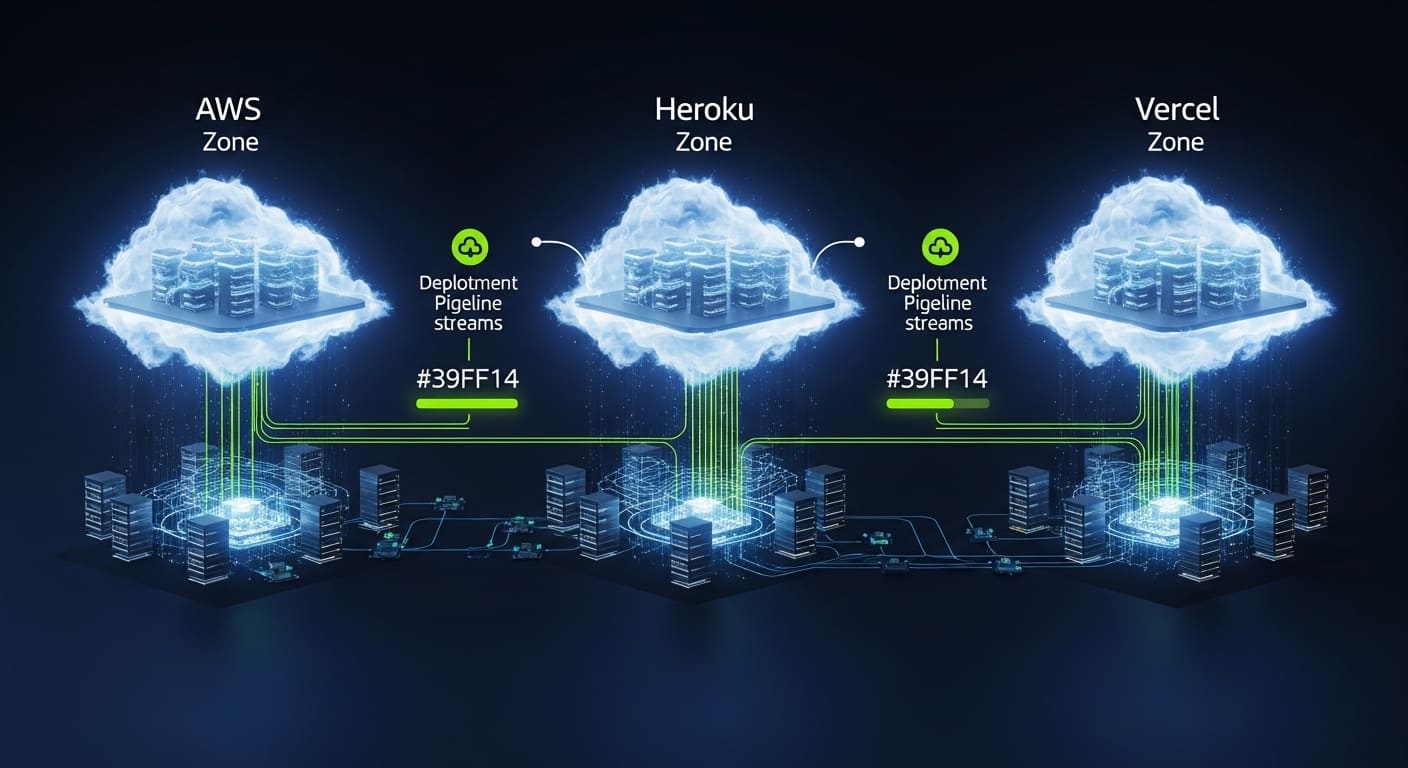
Choosing where to deploy your web application is one of the most consequential infrastructure decisions you will make — and one of the most confusing. AWS, Heroku, and Vercel represent three fundamentally different philosophies: AWS provides the raw cloud infrastructure with maximum control and complexity; Heroku offers a developer-friendly platform with managed abstraction; Vercel specializes in front-end and full-stack JavaScript deployment with a best-in-class developer experience. Each is the right choice in specific situations — and the wrong choice in others. This guide gives you the technical analysis, cost breakdown, and decision framework to choose correctly for your specific application.
What You Will Learn in This Article
- How AWS, Heroku, and Vercel fundamentally differ in architecture
- Detailed cost analysis for small, medium, and large applications
- Performance and scaling characteristics of each platform
- Developer experience and DevOps overhead comparison
- When each platform is the right choice
- The 2026 deployment landscape: new options to consider
- A decision framework for South Florida development teams
Platform Overview: Three Different Philosophies
Amazon Web Services (AWS)
AWS is not a single deployment platform — it is a collection of over 200 cloud services that you assemble into a deployment architecture. For a typical web application, you might use: EC2 or ECS for compute, RDS for the database, S3 for file storage, CloudFront for CDN, Route 53 for DNS, IAM for access control, CloudWatch for monitoring, and CodeDeploy or GitHub Actions for CI/CD. AWS gives you complete control over every layer of your infrastructure — which means you are also responsible for configuring and maintaining every layer.
AWS philosophy: Maximum capability, maximum responsibility. You get the most powerful and flexible infrastructure available, but the operational burden is significant. AWS is the right choice when you need specific AWS services, when security and compliance requirements demand it, or when your application requires custom infrastructure configuration that platform-as-a-service tools cannot provide.
Heroku
Heroku was built on the principle of developer productivity: deploy your application without worrying about infrastructure. Its "dyno" model abstracts away servers — you define your application's process types and how much memory and CPU each needs, and Heroku manages the container infrastructure underneath. Heroku Connect, Heroku Data, and a rich add-on marketplace provide databases, caches, email, monitoring, and other services as one-click additions.
Heroku 2026 status: In February 2026, Heroku announced a "sustaining engineering model" — focused on stability and security, but no longer building new features or accepting new Enterprise contracts. While existing applications continue to run reliably, Heroku is no longer growing its capabilities. This is an important consideration for new projects that expect to need Heroku's features to evolve over time.
Vercel
Vercel specializes in deploying JavaScript and TypeScript web applications — particularly Next.js, which Vercel created. Its deployment model is built around the Jamstack and serverless principles: static files on a global CDN, with server-side logic running as serverless functions at the edge. Deploy by pushing to git — Vercel automatically builds, deploys, and creates preview URLs for every pull request.
Vercel philosophy: Developer experience and performance first. Zero-configuration deployment, automatic SSL, global CDN, automatic preview deployments, and first-class Next.js support make Vercel the fastest path from code to production for React and Next.js applications. The trade-off is less control over infrastructure and function execution time limits.
Real Cost Comparison: What You Actually Pay
Cost comparisons are only meaningful in context. Here are real costs for three application sizes:
Small Application (Startup / MVP): 1,000-10,000 monthly users
| Component | AWS (monthly) | Heroku (monthly) | Vercel (monthly) |
|---|---|---|---|
| Compute | t3.small EC2: ~$15 | Standard-1x Dyno: $25 | Pro plan: $20/user |
| Database | RDS db.t3.micro: ~$15 | Heroku Postgres Mini: $5 | Supabase/PlanetScale: $0-25 |
| SSL + CDN | CloudFront + ACM: ~$5 | Included | Included |
| Monitoring | CloudWatch: ~$5 | Basic included | Basic included |
| Total/month | ~$40-60 | ~$30-55 | ~$20-45 |
Medium Application: 10,000-100,000 monthly users
| Component | AWS (monthly) | Heroku (monthly) | Vercel (monthly) |
|---|---|---|---|
| Compute (2 instances for redundancy) | 2x t3.medium: ~$60 | 2x Standard-2x: $100 | Pro + usage: ~$40-80 |
| Database | RDS db.t3.small: ~$30 | Postgres Standard-0: $50 | Managed PostgreSQL: $25-50 |
| Redis cache | ElastiCache: ~$15 | Heroku Redis Mini: $15 | Upstash Redis: $10-20 |
| Load balancer | ALB: ~$20 | Included | Included (edge routing) |
| Total/month | ~$145-180 | ~$165-200 | ~$75-150 |
Large Application: 100,000+ monthly users
At scale, AWS's pricing model becomes more favorable because you can: reserve EC2 instances for 1-3 year commitments (60-70% discount), use spot instances for batch workloads (70-90% discount), and optimize each service independently. Vercel's serverless model can become expensive at high function invocation volumes. Heroku's per-dyno pricing scales linearly and becomes costly at large compute requirements. At enterprise scale, AWS almost always wins on total cost once engineering capacity for infrastructure management is accounted for alongside the platform costs.
Performance and Scaling
Vercel: Edge Performance as Default
Vercel deploys static assets and serverless functions to an edge network with 90+ locations globally. For South Florida users, assets are served from nearby edge nodes rather than a distant origin server, producing response times under 100ms for cached content. Vercel's serverless functions scale automatically to zero when not in use and scale up instantly on demand — no minimum instance running cost, but cold starts can add 100-500ms latency for infrequently called functions.
AWS: Scale to Any Requirement
AWS can handle any scale — Amazon itself runs on AWS, as do Netflix, Airbnb, and thousands of enterprises. The scaling mechanisms are more complex: Auto Scaling Groups for EC2, task scaling for ECS, Lambda concurrency limits for serverless. But AWS's reserved capacity, placement groups, and dedicated instances provide performance guarantees that serverless platforms cannot match for latency-sensitive applications.
Heroku: Reliable but Limited Scaling
Heroku scales by adding dyno instances horizontally. Standard dynos have a known performance profile and scale predictably. However, Heroku's infrastructure is built on AWS and adds an abstraction layer that means you get somewhat less compute per dollar than running on AWS directly. Heroku's free tier was removed in 2022; all paid dynos run 24/7 and bill accordingly.
Developer Experience and DevOps Overhead
| Factor | AWS | Heroku | Vercel |
|---|---|---|---|
| Initial setup time | Days to weeks | Hours | Minutes |
| Preview deployments | Requires configuration | Requires configuration | Automatic on every PR |
| SSL certificate | Configure ACM + ALB | Automatic | Automatic |
| Custom domains | Route 53 + CloudFront | Simple dashboard | Simple dashboard |
| Rollback | Configure manually | One-click in dashboard | Instant rollback in dashboard |
| Monitoring | CloudWatch (configure) | Basic built-in | Analytics built-in |
| DevOps expertise needed | High | Low | Minimal |
The DevOps overhead of AWS is a real cost that rarely appears in simple price comparisons. A full-time DevOps engineer in South Florida commands $80,000-$130,000/year. If AWS's infrastructure management requires even 20% of a developer's time, that is a $16,000-$26,000 annual cost above the raw hosting bill — which eliminates most of AWS's cost advantage for smaller teams.
When to Choose Each Platform
Choose Vercel when:
- Your application is a Next.js, React, Vue, Svelte, or Nuxt project
- You want the fastest path from development to production
- Your team is small (1-5 developers) and devops is not a core competency
- You need automatic preview deployments for every pull request
- Serverless function execution time limits (10-60 seconds) are acceptable for your use case
- Budget: startup / small business with <$500/month infrastructure budget
Choose Heroku when:
- Your team is migrating from Heroku and changing platforms would require significant refactoring
- You need Heroku-specific add-ons that would require significant migration effort
- Your application runs long-running background processes that do not fit serverless models
- Note: For new projects in 2026, consider Railway or Render as Heroku alternatives with better pricing and active feature development
Choose AWS when:
- Your application requires specific AWS services (SQS, SNS, Kinesis, Rekognition, Bedrock, etc.)
- Compliance requirements (HIPAA, SOC2, PCI-DSS) are mandatory and you need AWS compliance certifications
- You have or are building a dedicated DevOps/infrastructure engineering capability
- Your application is at a scale where the infrastructure optimization AWS enables translates to significant cost savings
- You need fine-grained control over network topology, security groups, or compute placement
The 2026 Deployment Landscape: Additional Options
Beyond the three main platforms, several strong alternatives have emerged in 2025-2026:
- Railway: The most Heroku-like experience with modern pricing ($5/month minimum) and active feature development — widely recommended as a Heroku replacement for new projects
- Render: Similar to Railway, with free tier, PostgreSQL, Redis, and static site hosting in a unified dashboard
- Cloudflare Pages + Workers: Vercel competitor with strong performance on Cloudflare's global network; particularly competitive for applications with heavy edge computing requirements
- Fly.io: Runs Docker containers on hardware distributed globally; strong for applications that need more compute control than serverless but more simplicity than AWS
For most South Florida businesses launching a new custom web application in 2026, the recommendation is: start on Vercel (for Next.js/React) or Railway (for Node.js APIs), and migrate to AWS when your scale and engineering team justify the operational investment.
Frequently Asked Questions
Which deployment platform is best for a startup web application?
For most startup web applications, Vercel is the best starting deployment platform in 2026 for React/Next.js front ends, combined with a managed database service like Supabase or PlanetScale. The zero-configuration deployment, automatic preview environments, and generous free tier let small teams ship faster. When your application outgrows Vercel's serverless model or your infrastructure needs require AWS-specific services, migrate then — not preemptively.
Is AWS cheaper than Vercel for production applications?
For small to medium applications with teams without dedicated DevOps engineers, Vercel is typically cheaper in total cost (hosting + DevOps labor). For large applications with dedicated infrastructure engineers, AWS's reserved pricing and optimization capabilities make it cost-competitive or cheaper at scale. The comparison must include engineering time, not just raw hosting costs.
Can I use Vercel for my Node.js backend API?
Yes — Vercel supports Node.js serverless functions as API routes within Next.js applications. For standalone Node.js APIs (Express, Fastify), Vercel's serverless function model supports them but with execution time limits (typically 10-60 seconds depending on plan) and cold start latency considerations. For APIs requiring persistent connections, long-running processes, or WebSocket connections, a container-based platform (Railway, Render, AWS ECS) is more appropriate.
Conclusion
The right deployment platform for your web application depends on your team size, application architecture, scale requirements, and operational capacity. Vercel wins for Next.js and React applications where developer experience and speed to production are priorities. AWS wins for large-scale applications, compliance requirements, and teams with dedicated infrastructure expertise. Heroku serves existing workloads well but is no longer the first choice for new projects. For South Florida businesses commissioning custom web application development, SENAVIA Corp evaluates deployment requirements as part of every project architecture — selecting and configuring the platform that best balances performance, cost, and operational overhead for your specific situation. Contact us today to discuss your web application deployment requirements.