Table of Contents Tabla de Contenido
- What You Will Learn in This Article
- Understanding REST APIs
- Understanding GraphQL
- When REST Is the Right Choice
- When GraphQL Is the Right Choice
- The N+1 Problem: GraphQL's Main Performance Risk
- The Hybrid Architecture: REST + GraphQL
- Performance Comparison
- Security Considerations
- Frequently Asked Questions
- Conclusion
Every custom web application needs an API — a communication layer that lets the front end request data from the back end. For most of software history, REST (Representational State Transfer) was the unquestioned standard. In 2012, Facebook introduced GraphQL to solve the specific data-fetching problems their mobile apps were creating, and in the years since, GraphQL has grown from an internal tool to a technology that nearly half of all new API projects now consider first. Enterprise adoption of GraphQL has grown over 340% since 2023. But REST still dominates overall API usage. So which do you choose for your custom application? The answer depends on your specific requirements — and this guide gives you the framework to decide correctly.
What You Will Learn in This Article
- What REST APIs and GraphQL are, and how they work
- The fundamental technical differences that affect real applications
- When REST is clearly the right choice
- When GraphQL is clearly the right choice
- The N+1 problem and how to handle it in GraphQL
- The hybrid architecture approach for complex applications
- Performance, security, and caching considerations
Understanding REST APIs
A REST API (Representational State Transfer Application Programming Interface) structures your backend around resources — things like users, orders, products, messages — and exposes them through predictable URLs with standard HTTP methods.
The REST paradigm maps naturally to how HTTP works: GET to retrieve, POST to create, PUT or PATCH to update, DELETE to remove. Each endpoint returns a fixed data structure — request GET /users/123 and you always get the full user object, regardless of what fields the front end actually needs. REST APIs are the backbone of the modern web: every major platform (Stripe, Twilio, GitHub, Webflow) exposes REST APIs for third-party integration.
REST Strengths
- Simplicity: Every developer understands HTTP methods and URL structure — no new query language to learn
- Caching: HTTP caching works natively with REST — GET endpoints can be cached at CDN level, browser level, and proxy level with zero configuration
- Tooling maturity: Decades of tooling — API clients, testing tools, documentation generators, monitoring — all optimized for REST
- Third-party compatibility: Every client can call a REST API — mobile apps, other servers, browser fetch, IoT devices
- Simplicity in debugging: A REST request is a plain HTTP request you can inspect in browser DevTools, curl, or any HTTP client
Understanding GraphQL
GraphQL is a query language for APIs — not a protocol, but a specification for how clients can request exactly the data they need. Instead of dozens of specific endpoints, GraphQL exposes a single endpoint (typically /graphql) that accepts queries describing the exact fields and relationships the client needs.
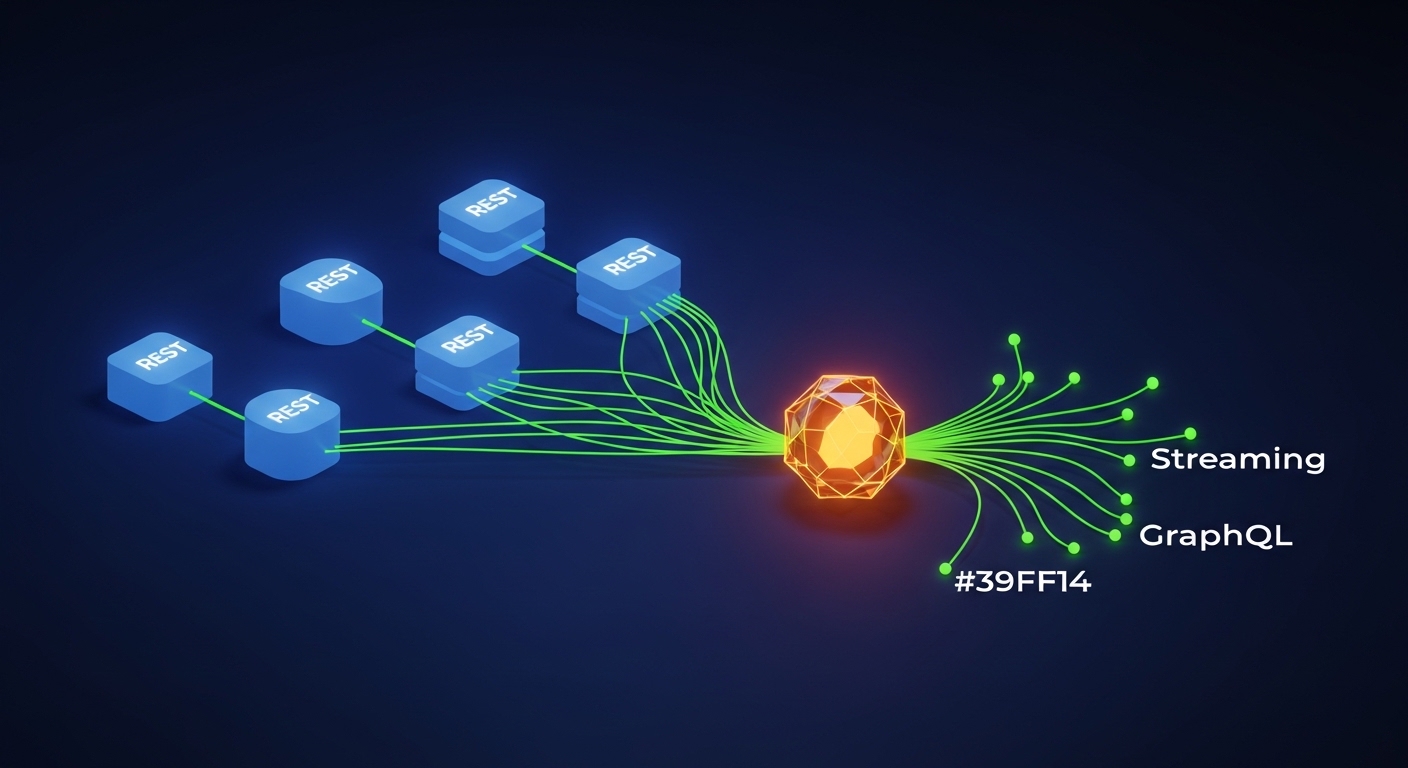
A GraphQL query for a user profile might request: user name, email, their last 5 orders with product names and prices, and their account settings — all in one request, returning only those specific fields. With REST, this would require three separate requests to three different endpoints, then assembling the data in the client. This is the "over-fetching" and "multiple roundtrip" problem GraphQL was designed to solve.
GraphQL Strengths
- Client-specified data: Clients request exactly what they need — no more, no less — reducing bandwidth and parsing overhead
- Single endpoint: One URL for all queries; the query itself defines what data is returned
- Strongly typed schema: The GraphQL schema is the single source of truth for your API — self-documenting, explorable via GraphiQL, and type-safe
- Efficient for complex data: Fetching nested, related data in a single request is GraphQL's core strength
- Frontend independence: Front-end teams can iterate on data requirements without requiring back-end changes
When REST Is the Right Choice
Choose REST in these situations:
Public APIs and Third-Party Integrations
If your API will be consumed by third-party developers, external partners, or integrations with other systems, REST is almost always the right choice. REST APIs are universally understood, easy to test with tools like Postman or curl, and compatible with any client platform. GraphQL adds a learning curve and query complexity that third-party developers should not need to navigate.
Simple CRUD Applications
If your application primarily creates, reads, updates, and deletes resources with relatively flat data models — a task management app, a content management system, a simple booking tool — REST maps to these operations naturally and without overhead. The added complexity of GraphQL schema design, resolvers, and query parsing is not worth it for simple CRUD.
File Uploads and Binary Data
REST handles file uploads natively through multipart form data. GraphQL file uploads require additional complexity (the graphql-multipart-request-spec specification and additional server configuration). For applications that upload images, PDFs, or other files as a primary feature, REST simplifies this significantly.
Aggressive Caching Requirements
REST APIs benefit from HTTP caching out of the box — a GET endpoint for a product catalog can be cached at CDN level with appropriate Cache-Control headers, serving millions of requests without hitting your origin server. GraphQL mutations and queries all go to the same endpoint via POST (in most implementations), which bypasses standard HTTP caching. For public-facing APIs serving high read traffic, REST's caching advantage can be significant.
When GraphQL Is the Right Choice
Multiple Client Types with Different Data Needs
GraphQL was built at Facebook precisely because they had a mobile app that needed minimal data (small screens, limited bandwidth) and a web app that needed rich data — and building separate REST APIs for each was unsustainable. If you have iOS, Android, and web clients with different data requirements, GraphQL lets each client request exactly what it needs from a single API, without creating multiple API versions or endpoints.
Complex Nested Data Relationships
Social networks, marketplaces, project management tools, and analytics dashboards often require fetching deeply nested, related data: a project with its tasks, each task with its assignee, each assignee with their permissions and profile. With REST, this requires multiple sequential requests. With GraphQL, one query returns the entire data graph in a single round trip.
Rapid Front-End Development
GraphQL enables front-end teams to iterate on data requirements without waiting for back-end changes. A new UI component that needs a slightly different combination of user fields can write a new GraphQL query against the existing schema without any back-end work. In teams where front-end development speed is the priority, this independence is a significant accelerator.
The N+1 Problem: GraphQL's Main Performance Risk
The most important technical challenge in GraphQL is the N+1 problem: a client requests a list of N items, and the naive GraphQL resolver makes N additional database queries to fetch a related field for each item. A query for 100 posts with their authors triggers 100 separate database queries for authors — a massive performance issue at scale.
The solution is DataLoader, a library that batches and caches database requests. Instead of making 100 separate author queries, DataLoader collects all author IDs requested across a single GraphQL resolution cycle and makes one batched query: "get all users with IDs [1, 2, 3..., 100]". In 2026, DataLoader patterns and persisted queries have become standard in any serious GraphQL deployment.
Additional safeguards for production GraphQL:
- Query complexity analysis: Limit the depth and complexity of queries to prevent denial-of-service through extremely nested requests
- Persisted queries: Pre-register allowed queries on the server; reject anything not in the registry — prevents malicious complex queries
- Field-level authorization: Ensure sensitive fields check permissions at the resolver level, not just the API level
The Hybrid Architecture: REST + GraphQL
In 2026, sophisticated enterprise architectures often use both REST and GraphQL for different purposes:
| Use Case | Recommended Approach |
|---|---|
| Public APIs and third-party webhooks | REST |
| Internal app APIs (BFF — Backend For Frontend) | GraphQL |
| Microservice-to-microservice communication | REST or gRPC |
| Complex client data aggregation | GraphQL Federation |
| File uploads | REST |
| Real-time subscriptions | GraphQL Subscriptions (WebSocket) |
For custom applications built by South Florida businesses, a pragmatic starting point is REST for the initial build — simpler to implement, debug, and explain to stakeholders — with a planned migration to GraphQL for the front-end data layer if and when multiple client types or complex data nesting make GraphQL's advantages clear.
Performance Comparison
Raw performance depends heavily on implementation quality, not just the choice of REST vs GraphQL. In general:
- Simple requests: REST is slightly faster because there is no GraphQL parsing overhead
- Complex data fetching: GraphQL can be significantly faster by reducing the number of HTTP round trips
- Bandwidth: GraphQL reduces over-fetching, which matters on mobile networks; REST sends fixed response shapes that may include unneeded data
- Caching: REST wins at the HTTP/CDN layer; GraphQL requires application-level caching strategies
Security Considerations
Both REST and GraphQL require careful security implementation. GraphQL's single-endpoint model and flexible queries introduce specific risks:
- Introspection exposure: Disable GraphQL schema introspection in production — it reveals your entire API structure to attackers
- Query depth limiting: Set a maximum nesting depth to prevent exponentially complex queries
- Field-level authorization: Implement authorization checks at the resolver level, not just the gateway level
- Rate limiting: Apply rate limits per operation, not just per endpoint, since a single GraphQL request can trigger complex operations
Frequently Asked Questions
What is a REST API?
A REST API (Representational State Transfer API) is a web service architecture that structures API access around resources (users, products, orders) accessed through standard HTTP methods (GET, POST, PUT, DELETE) at predictable URLs. Each endpoint returns a fixed data structure, and REST is the most widely used API pattern for web services.
What is GraphQL and how does it differ from REST?
GraphQL is a query language for APIs that lets clients specify exactly what data they need in a single request. Unlike REST, which has multiple endpoints each returning fixed data shapes, GraphQL has a single endpoint where clients send queries describing the exact fields and relationships they want. GraphQL is stronger for complex, nested data; REST is stronger for simplicity, caching, and public APIs.
Can I switch from REST to GraphQL after my app is built?
Yes — it is possible but requires significant refactoring. A common migration pattern is to add a GraphQL layer on top of existing REST endpoints, gradually moving functionality to native GraphQL resolvers. For most applications, it is better to make the REST vs GraphQL decision before building, since the API architecture affects database query patterns, authorization logic, and client code structure.
Does GraphQL replace the need for a database?
No — GraphQL is an API query language, not a database. GraphQL resolvers (the functions that execute queries) call your database just as REST controllers do. The difference is in how the client specifies what data it needs, not in where or how the data is stored. GraphQL works with any database: PostgreSQL, MongoDB, MySQL, DynamoDB, or any combination.
Conclusion
Choosing between REST APIs and GraphQL is a technical decision with long-term architectural consequences. REST is the right default for most applications — simpler, better cached, universally understood. GraphQL pays for itself when you have multiple client types with different data needs, complex nested data relationships, or front-end teams that need to iterate rapidly without back-end changes. For businesses in South Florida commissioning a custom web application, understanding this distinction early prevents expensive architectural re-work later. At SENAVIA Corp, we assess your application's specific data requirements and recommend the API architecture that minimizes complexity while meeting your performance and scalability needs. Contact us today for a technical consultation on your custom application project.